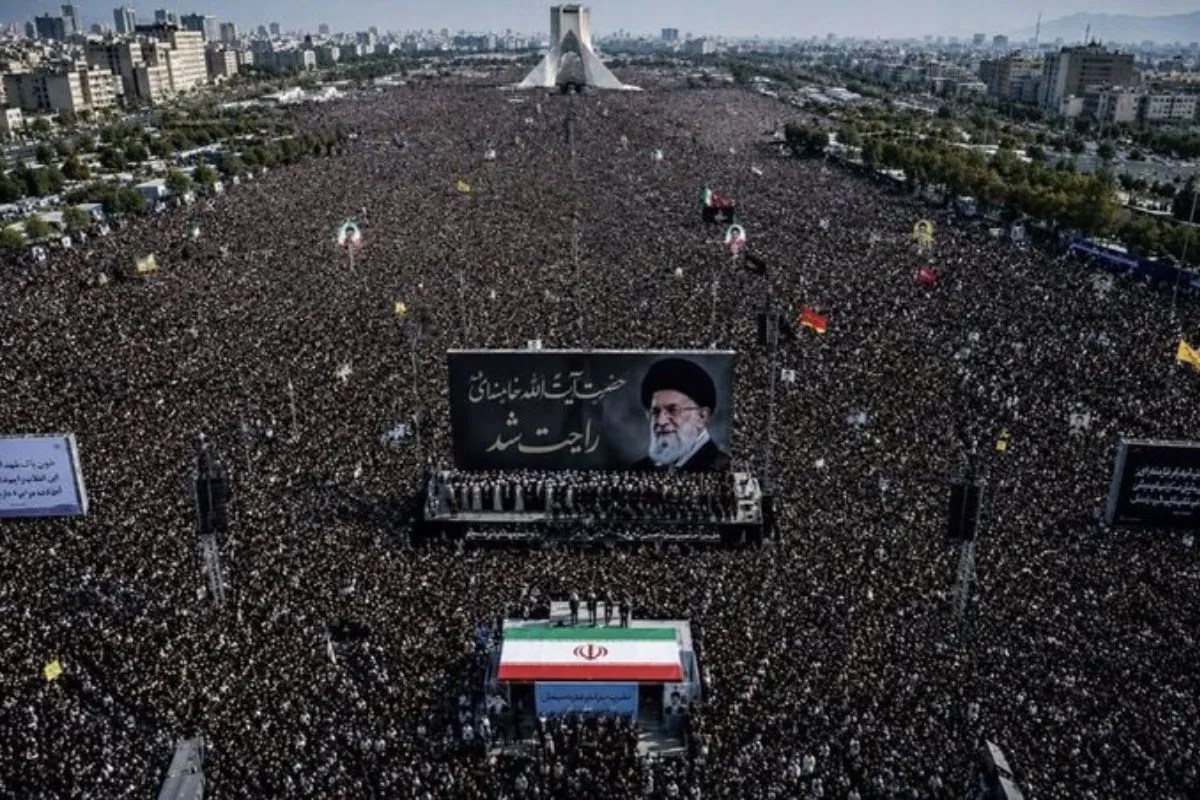
The mainstream media loves a good funeral. They especially love an Iranian state funeral. Whenever a high-ranking regime figure dies, the cameras roll, the anchors lower their voices, and the footage of packed streets takes over the screen. You see the burning effigies. You see the printed posters demanding retribution. You see the sea of black chadors and clenched fists.
The immediate, lazy consensus from Western commentators is always the same. They claim this collective outpouring represents the unified, unbreakable will of the Iranian population. They warn that the Middle East is on the verge of total explosion because of the sheer volume of people in the streets. They mistake choreographed state theater for genuine, grassroots geopolitical momentum.
It is a complete illusion.
If you are analyzing Iranian political stability by counting the number of effigies hung from bridges in Tehran, you are falling for the oldest trick in the authoritarian playbook. The reality is far more fragile, far more cynical, and entirely disconnected from the narrative broadcasted to the West. The spectacle of the street is not a display of absolute power. It is a desperate mechanism of internal control.
The Economics of the Forced Crowd
Let's look at how these massive gatherings actually happen. Having spent years tracking regional security data and state-backed mobilization tactics, I can tell you that an Iranian state funeral is a highly bureaucratic logistics operation. It is not an organic gathering of grieving citizens.
The Islamic Republic operates a massive apparatus of state-employed workers, civil servants, and military families. When a major state event is declared, attendance is not optional for this sector.
- The Basij Network: The state mobilizes the paramilitary Basij forces from every province, bussing them into the capital free of charge. These individuals rely on the regime for educational quotas, government jobs, and direct financial stipends.
- The Closed Offices: Government ministries, public schools, and state-run banks are routinely shut down on these days. Employees are expected to register their presence. Failing to show up can result in immediate blacklisting, loss of promotion opportunities, or termination.
- The Free Lunch: In an economy battered by years of severe inflation and mismanagement, the regime uses basic incentives. Free meals, juices, and transportation are distributed at mass transit hubs to swell the ranks of the crowd.
To look at a crowd of two million people in Tehran and conclude that the entire nation is ready to march to war is the geopolitical equivalent of looking at a mandatory corporate team-building exercise and concluding that every employee loves upper management. It is a fundamental misunderstanding of how authoritarian coercion functions.
The English Poster Paradox
Look closely at the imagery that dominates the coverage of these events. The posters reading "Kill Trump" or cursing Western leaders are almost never handwritten. They are professionally designed, mass-printed on high-quality gloss paper, and written in flawless English.
Ask yourself a simple question. Why would a grieving citizen in Tehran, supposedly consumed by raw, localized religious fervor, take the time to translate their anger into the language of the global media?
They wouldn't. The posters are printed by the Islamic Propagation Organization. They are designed specifically for the lens of Western photojournalists. The regime understands the Western news cycle perfectly. They know that a sign written in Persian will not make the front page of an American news site. A sign written in English, targeting an American political figure, guarantees international coverage.
The Western media plays its assigned role flawlessly. By broadcasting these images without context, they validate the regime's primary domestic lie: that the government and the people are one single, angry entity.
The Silent Majority and the Great Disconnect
While the cameras focus on the three blocks of orchestrated fury, they ignore the rest of the country. Iran is a nation of nearly 90 million people. The vast majority of the population is under the age of 40. They are highly educated, deeply connected to the outside world through VPNs, and profoundly exhausted by decades of ideological conflict.
The true state of Iranian public opinion is found not in the funeral processions, but in the historic lows of voter turnout during recent elections. It is found in the widespread civil disobedience of the Woman, Life, Freedom movement. It is found in the labor strikes that regularly paralyze the country’s energy sector without receiving a fraction of the international media coverage given to a state funeral.
When you look at the hard data, the disconnect becomes undeniable.
| Metric | State Funeral Narrative | Ground Reality |
|---|---|---|
| Public Sentiment | Unified ideological rage against external enemies | Deep-seated economic resentment toward internal corruption |
| Mobilization | Spontaneous, organic grassroots mourning | Mandatory, state-subsidized logistical operations |
| Demographics | Represents the entire Iranian populace | Represents a shrinking core of regime loyalists and dependents |
The downside of acknowledging this reality is that it forces Western policymakers to abandon the simplistic "clash of civilizations" model. It requires a nuanced understanding of a country that is internally fractured. The regime is fighting a two-front war: a cold war with its regional rivals, and a quiet, existential war against its own youth.
Miscalculating the Threshold of Escalation
The danger of the competitor's lazy reporting is that it drives terrible foreign policy decisions. When Western analysts believe the theater, they miscalculate the regime's actual thresholds for escalation.
Authoritarian regimes use maximalist rhetoric precisely because their conventional capabilities are limited. The threats yelled from podiums during funerals are a substitute for actual strategic leverage. The regime knows that a direct, conventional confrontation with a superpower would mean the immediate destruction of its infrastructure and the potential collapse of its domestic control.
Therefore, the theater must be loud. The effigies must be hung. The flags must be burned. It gives the illusion of action to a domestic base that requires constant ideological feeding, while allowing the leadership to avoid the actual, suicidal step of launching an unmanageable war.
Stop reading the headlines that treat state-sponsored performance art as genuine news. The next time you see a sea of black chadors and a burning effigy on your screen, don't see a nation united in rage. See a regime that is terrified of its own people, using a massive PR campaign to convince the world—and itself—that it still holds the mandate of the street.