The air inside the convention hall always smells the same. It is a potent, dizzying mixture of stale coffee, expensive wool suits, ozone from industrial lighting, and the distinct, electric scent of raw human ambition. If you stand near the back, right where the cable runners snake across the concrete floor like black vines, the noise hits you not as distinct voices, but as a low, vibrating hum.
It is the sound of a party trying to figure out who it is.
For the last decade, that identity was settled. It belonged to one man, an undeniable gravitational force that bent every news cycle, every policy debate, and every local precinct meeting to his will. But political gravity is a strange thing. Just when it feels absolute, the calendar turns, the rules change, and the future arrives ahead of schedule.
A fresh stack of data just landed on the desks of strategists from Washington to Palm Beach. It is a poll, cold and numerical, charting the early preferences for the 2028 Republican presidential nomination. On paper, it looks like a statistical tie, a neat grid of percentages and margins of error.
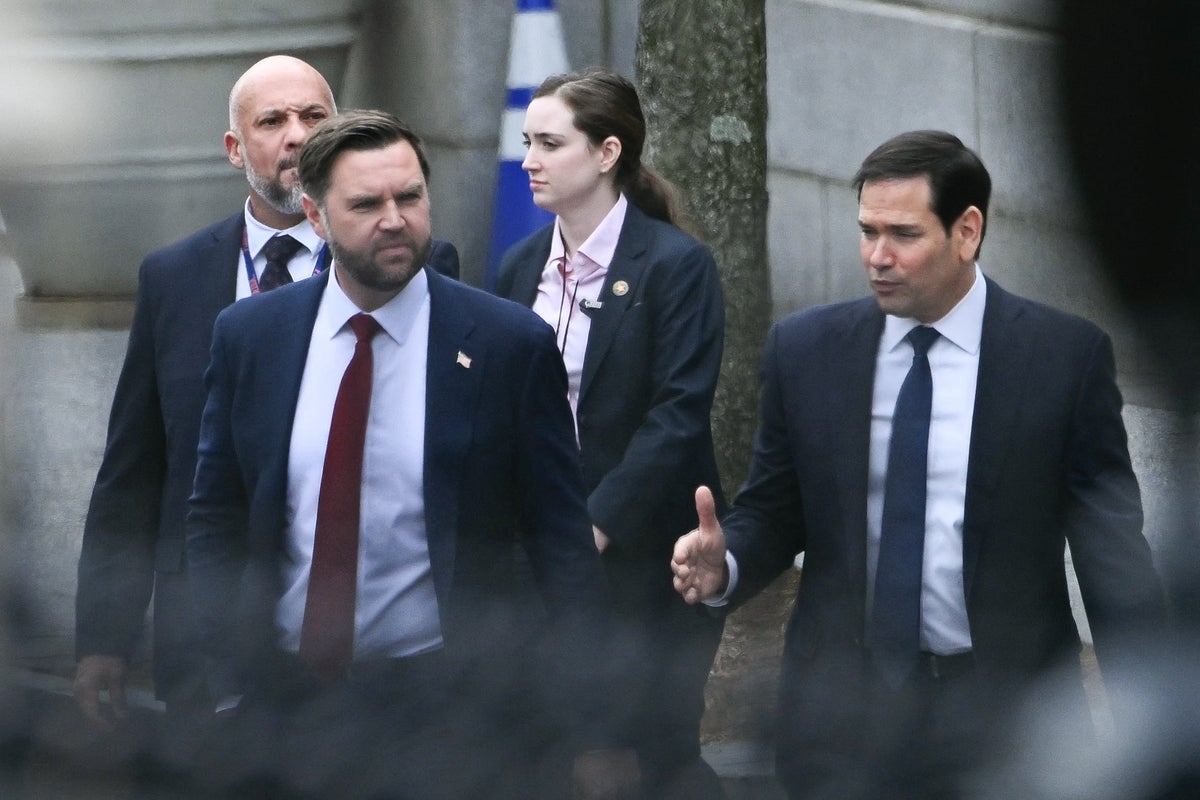
JD Vance and Marco Rubio are locked in a dead heat.
But numbers are just ghosts left behind by human choices. To understand what is actually happening, you have to look past the spreadsheets. You have to look at the two men standing at the edge of the stage, watching the crowd, each believing they hold the secret key to the American soul.
Two Men, One Mirror
Think of this race not as a standard policy debate, but as a generational tug-of-war over the meaning of working-class anxiety.
On one side is the boy from the Rust Belt who wrote his way out of the hills and into the halls of power. JD Vance does not look like the traditional country-club Republican of the nineties. He speaks with the deliberate, heavy cadence of the Ohio River valley. When he talks about trade, factories closing, or the quiet devastation of the opioid crisis, he isn't quoting a think-tank white paper. He is talking about his neighbors. His family. Himself.
His appeal is rooted in a specific kind of grievance. It is the feeling of being left behind by a globalized economy that cared more about efficiency than community. For the voter sitting in a diner in eastern Ohio, Vance represents a shield. He is the intellectual warrior who went to Ivy League schools just to learn how the enemy thinks, coming back equipped to dismantle the system from within.
Then, look across the aisle of the same party.
Marco Rubio represents a different American dream, one burnished by the neon glow of Miami and the fierce, protective patriotism of the exiled. He is the son of a bartender and a maid who fled a communist revolution. His story is one of aspiration, of a system that worked exactly as intended because a family could arrive with nothing and see their son become a United States Senator.
Where Vance offers a shield, Rubio offers a ladder.
Rubio’s conservatism is traditional but adaptive. He has spent years quietly reshaping his policy platform to focus on the dignity of work, family tax credits, and the structural threat posed by foreign adversaries. He speaks with the fluid, rapid-fire urgency of a seasoned campaigner who knows how to bridge the gap between the old guard of the party and the new, populist coalition.
They are staring at the same voters, but they are seeing entirely different needs.
The Quiet Evolution of the Ballot Box
To truly grasp the stakes, we have to look at how we got here.
For generations, American politics operated under a comfortable set of rules. The Republican party was the home of free enterprise, small government, and a muscular foreign policy. The Democrats were the party of labor and the working class. It was a neat, predictable divide that Ivy League professors could map out on a chalkboard with absolute certainty.
Then the chalkboard shattered.
Consider a hypothetical voter named Frank. Frank lives in a suburb outside of Pittsburgh. Twenty years ago, Frank was a registered Democrat, just like his father and grandfather. He believed in the union. He believed the party looked out for the guy in the steel-toed boots. But over the last decade, Frank felt the cultural and economic ground shifting beneath his feet. The factories didn't come back. The language used by political elites began to sound like a foreign dialect.
Frank didn't leave his party. He felt his party left him.
When the populist wave broke over the country, Frank found a new political home. He didn't want a lecture on the virtues of global free trade. He wanted someone to say, I see you, and I will fight for you.
This is the coalition Vance and Rubio are fighting to inherit. The poll numbers are neck-and-neck because both men understand Frank perfectly, but they are offering him two completely different remedies for his anxiety.
Vance’s diagnosis is systemic. He argues that the global economic order is fundamentally broken and must be aggressively reordered. If that means imposing massive tariffs, breaking up monopolies, or pulling back from foreign entanglements to focus on domestic renewal, so be it. It is a philosophy of protection.
Rubio’s diagnosis is structural but faithful to the American experiment. He argues that the system doesn't need to be burned down; it needs to be steered toward the common good. He believes the power of American capitalism can be harnessed to rebuild the family unit and secure national independence without abandoning the foundational principles of free enterprise or America's role as the leader of the free world. It is a philosophy of resilience.
The tie in the polls isn't a sign of voter indecision. It is a sign of a deep, philosophical crossroads.
The Chemistry of the Crowd
Watching them navigate a room is a study in political theater.
Vance possesses a stillness that can feel intimidating or deeply comforting, depending on your perspective. He does not chase the applause line. He delivers his arguments like a prosecutor making a closing argument to a jury that has already made up its mind. There is a darkness to his rhetoric, a willingness to confront the decline of American institutions head-on, that resonates with voters who feel the country is slipping away.
Rubio is all motion, energy, and rhetorical flight. When he catches a rhythm, he can elevate a crowded gymnasium, tapping into the classic, optimistic cadence of American exceptionalism. He represents the possibility of a populism that smiles, a movement that seeks to persuade rather than just defeat.
The danger for Vance is that his stark realism can occasionally taste like bitterness, alienating suburban voters who want stability rather than a perpetual cultural civil war. The danger for Rubio is that his polish can look like the old establishment in a new coat of paint, triggering the deep-seated skepticism of a base that has been promised change before and received only compromises.
This is the friction that makes the 2028 race so volatile, even this far out from the first primary ballots.
The Invisible Stakes
It is easy to look at early polling and dismiss it as a parlor game for political insiders. After all, years will pass before a single actual vote is cast. Alliances will shift. New crises will emerge. The world will change in ways we cannot predict sitting here today.
But dismissing these numbers misses the point entirely.
The battle between Vance and Rubio is not just about who gets to sit in the Oval Office. It is a proxy war for the soul of the conservative movement, and by extension, the direction of the entire country. The winner of this argument will decide what the American right looks like for the next quarter-century.
Will it be an nationalist, inward-looking movement that views the federal government as a tool to be wielded against cultural and economic adversaries? Or will it be a reformed, aspirational conservatism that seeks to use traditional levers to lift the working class while maintaining the nation's historic global commitments?
The answer to that question affects everything. It dictates the taxes Frank will pay in Pittsburgh. It determines whether a factory opens in Ohio or closes in Munich. It decides where American soldiers are deployed and how American families are supported.
The poll is just a snapshot, a single frame from a long, complex film that is still being shot.
Back in the convention hall, the hum never stops. The strategists will continue to argue over decimal points, margins of error, and demographic cross-tabs. They will try to turn the messy, emotional, contradictory reality of human nature into a predictable science.
But out in the country, away from the spotlights and the teleprompters, the voters are listening. They are weighing the shield against the ladder. They are waiting to see which man can look at their struggles and offer not just an echo of their anger, but a vision of a future they can actually believe in.
The stage is set, the lights are blindingly bright, and the two men are standing shoulder to shoulder, waiting for the music to start.