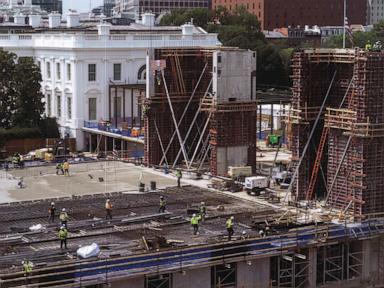
Chief Justice John Roberts issued an administrative stay on Friday, effectively allowing construction of the controversial White House ballroom project to proceed while the Supreme Court evaluates an emergency petition from the Justice Department. This temporary order blocks a lower court mandate that would have forced a work stoppage on the above-ground portion of the 90,000-square-foot expansion. While the administration frames the project as a critical military and security necessity, the legal battle highlights a deepening conflict over executive authority versus congressional oversight. The high court now faces the task of determining whether the current construction constitutes a valid exercise of presidential power or a bypass of legislative approval.
The project began last year with the abrupt demolition of the historic East Wing. Since then, the site has transformed into a high-intensity work zone where crews operate twenty hours a day, seven days a week. Government filings indicate the project is roughly 65 percent complete, a figure the administration uses to argue that a stoppage is now effectively impossible. This race against judicial intervention appears to be a calculated strategy. By accelerating construction during the appeals process, the executive branch creates a reality on the ground that renders future court injunctions functionally moot.
Beyond the aesthetic and historic preservation concerns raised by the National Trust for Historic Preservation, the case centers on the constitutional limits of executive self-help. Lower courts have been explicit: the president serves as a temporary steward of the White House, not its owner. The D.C. Circuit Court of Appeals recently ruled that substantial modifications to federal property require congressional authorization. The administration’s rebuttal relies heavily on the "national security" defense, claiming the ballroom serves as an essential protective shell for an integrated underground military complex that includes emergency shelters and advanced medical facilities.
Observers note that the national security argument emerged prominently only after initial legal challenges stalled the project. Originally marketed as a venue for state functions funded through private contributions, the narrative shift suggests a broader intent to shield the expansion from the legislative scrutiny typically required for federal infrastructure. If the executive branch can reclassify construction projects as vital security infrastructure, it effectively nullifies the ability of other branches to exercise oversight on the nation’s most iconic federal property.
This creates a dangerous dynamic for the separation of powers. The courts are currently functioning as a makeshift construction manager, forced to parse which aspects of the building are "strictly necessary" for security and which are purely elective. If the Supreme Court ultimately decides to allow the project to finish, it sets a precedent where an administration can essentially outpace judicial review through sheer force of industrial speed. The project’s physical completion would likely lead the court to treat the matter as settled by the weight of existing investment, regardless of the initial lack of legislative approval.
Critics argue that allowing the build to continue under an administrative stay is a de facto victory for the executive. Each day of continued work makes the prospect of demolition or radical alteration increasingly difficult, both financially and logistically. The administration is well aware of this reality. By the time the justices issue a durable ruling, the architectural footprint of the White House complex may be permanently altered.
The question before the Supreme Court is not merely about a ballroom. It is about whether a president possesses the unilateral authority to reshape the Executive Mansion’s footprint without the consent of the legislative branch. If the court validates the administration’s claim of broad discretionary power over federal sites based on security assertions, it effectively widens the aperture of executive control in ways that extend far beyond this specific project. History will look at the speed of the cranes and the silence of the marble, but the real story is playing out in the quiet, one-page orders that allow the concrete to harden while the law remains in limbo. The machinery of state continues to pour foundation, waiting to see if the judiciary will eventually call for a stop or accept the structure as an accomplished fact.


