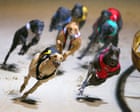
The pre-dawn air in regional Victoria doesn't just feel cold; it tastes like damp earth and rusted iron. It is 4:30 AM. Long before the first caffeine hit reaches the bloodstream of the working class, the trainers are awake. You can hear the rhythmic, hollow clicking of toenails on concrete—the sound of greyhounds shifting in their beds, waiting for the latch to lift.
For decades, this world operated on a simple, unspoken contract. Man breeds dog. Dog runs fast. Man feeds dog, keeps it warm, and prays for a clean line to the finish post. It is a subculture built on routine, sweat, and the pursuit of fractions of a second. But beneath the romanticized grit of the tracks at sand-blasted ovals like Ballarat or Cranbourne, a different kind of tension has been brewing. It is a friction between the hyper-regulated reality of modern animal racing and the chaotic, messy intrusion of human vice. If you enjoyed this piece, you might want to check out: this related article.
When news broke that a Victorian greyhound trainer had avoided a disqualification after their dog tested positive for benzoylecgonine, the internet did what it always does. It mocked. The headlines practically wrote themselves, painting a bizarre picture of a canine Scarface under the track lights.
The reality, however, is far quieter, far more tragic, and infinitely more complicated than a cheap punchline. For another perspective on this story, check out the latest update from The Athletic.
To understand how a racing dog ends up with cocaine metabolites in its system, you have to leave the grandstands behind and step into the suffocating proximity of a working kennel.
The Anatomy of a Positive Screen
A greyhound’s nose is a miracle of evolutionary engineering. Where a human possesses roughly five million olfactory receptors, a greyhound boasts closer to three hundred million. They do not merely smell the world; they map it, dissect it, and inhale it. If a microscopic particle exists within their environment, they will find it.
This brings us to the science of the swab.
When a dog wins, or when the stewards select it at random, it enters a brightly lit, sterile room that feels entirely divorced from the mud of the track. A vial of urine is taken. It is sealed, logged, and sent to a laboratory where mass spectrometers hunt for anomalies in parts per billion.
In this specific Victorian case, the anomaly was undeniable. Cocaine.
To the uninitiated, the immediate assumption is malice. The mind leaps to images of back-alley syndicates, desperate gamblers fixing races, and innocent animals being chemically manipulated to find an extra gear on the back straight. It feels like a cinematic betrayal of the animal.
But those who have spent their lives cleaning out stables and walking dogs along gravel roads know that the truth is usually much more mundane. And much harder to police.
Consider a hypothetical scenario, one that plays out across suburban and rural properties every single day. A trainer hires a casual hand to help with the morning turn-out. This worker, perhaps struggling with a personal demon entirely unrelated to the sport, party-hopped the night before. Residue lingers on the pads of their fingers. It sits on the fabric of their jeans. They reach down to adjust a racing muzzle or pat a sleek, aerodynamic head before the dog is loaded into the transport trailer.
The transfer is instantaneous. The dog licks its fur. The chemical enters the bloodstream. The trap is sprung.
The Verdict and the Ghost of Precedent
The Victorian Racing Tribunal sat in a room that smelled of old paper and anxiety. The trainer faced the ultimate professional oblivion: a lengthy ban that would strip away their livelihood, their identity, and the dogs they had raised from blind pups.
The defense did not argue that the drug was absent. The science made that impossible. Instead, the argument centered on contamination. It was a plea for mercy based on the sheer ubiquity of the substance in modern society.
Wastewater analysis across major Australian cities consistently reveals a stark reality: cocaine usage is not confined to wealthy inner-city enclaves. It flows through the plumbing of regional hubs and country towns alike. It sits on banknotes, petrol pumps, and the counters of local pubs. The racing industry, for all its efforts to create a bio-secure bubble around its athletes, cannot completely isolate itself from the environment its participants inhabit.
The tribunal looked at the evidence. They looked at the trainer's pristine record, the lack of a clear motive, and the minute concentration of the drug found in the sample.
They ruled. A fine, yes. A conviction on the record, certainly. But no ban.
The decision sent a shockwave through the sport’s purists. To some, it looked like a softening of the line, a crack in the zero-tolerance facade that keeps the industry palatable to a skeptical public. To others, it was a rare flash of institutional empathy—an acknowledgement that in a world covered in invisible contaminants, absolute perfection is an impossible standard.
The Invisible Stakeholders
We often forget who the real subjects of these dramas are. The human participants argue over legal definitions, mitigating circumstances, and the wording of rulebooks. They hire lawyers to dissect the exact threshold of a positive swab.
Meanwhile, the dogs simply wait.
A greyhound in racing fitness is an incredibly sensitive instrument. They are bundles of fast-twitch muscle fiber and deep, cavernous chests housing oversized hearts. They are hyper-attuned to the emotional states of their handlers. When a kennel is stressed, the dogs know it. When a trainer is staring down the barrel of a career-ending charge, the tension ripples down the lead.
The debate around this case isn't really about a single positive swab. It is about a deeper, systemic anxiety. The industry is trapped in a permanent defensive crouch, constantly trying to prove its legitimacy to an outside world that views it with increasing suspicion. Every positive test, regardless of the context, is ammunition for those who want to see the tracks dug up and turned into housing estates.
The trainers know this. They live with the paranoia. They wash their hands until the skin cracks. They lock their feed rooms. They vet their staff like high-security firms vetting intelligence officers. Yet, as this case proved, you cannot fence out the ghost in the machine.
The Sand at the End of the Straight
Watch a greyhound race from the rail sometime. Not on a television screen with a digital overlay and a commentator yelling over the noise, but right against the fence where the wind from the pack hits your face.
There is a moment, just as they round the final turn, where the sound changes. The frantic scuffling of paws on the raked sand gives way to a heavy, synchronized thudding. It sounds like a single engine running at maximum revs. For those few seconds, the politics of the sport, the administrative overreach, and the contamination statistics vanish. There is only the raw, ancient desire to chase.
The Victorian trainer returned to the kennels after the verdict, the threat of the ban lifted but the weight of the ordeal remaining. The dogs didn't care about the tribunal's findings. They didn't understand that their world had almost been upended by a microscopic trace of a chemical they had no way of comprehension.
The latch lifted. The clicking of nails on concrete began again. The routine resumed, fragile as ever, under a sky that was just beginning to turn from grey to gold.