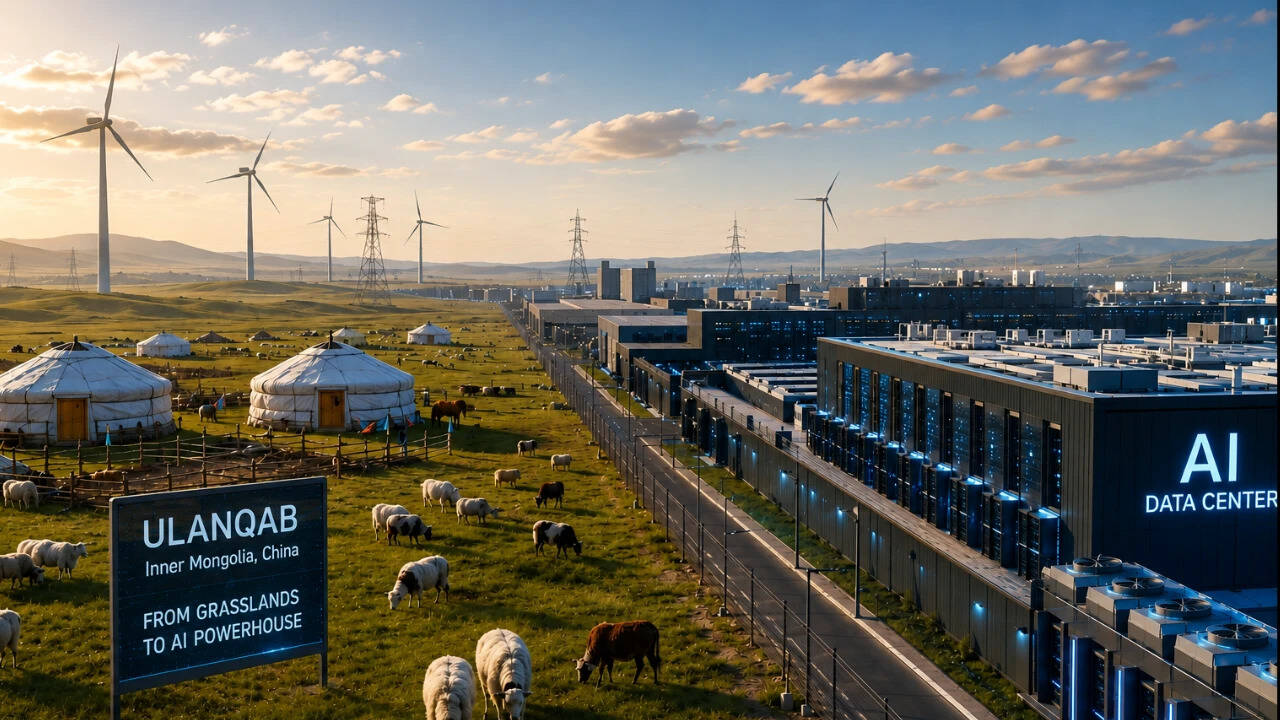
The wind does not ask for permission to cross the steppe. It rolls off the Siberian taiga, sweeps down across the endless, ochre expanse of Inner Mongolia, and howls over shortgrass plains that have known nothing louder than the thrum of a horse’s gallop for a thousand years. Until now.
Stand on a ridge near Hohhot today, and you will hear a different sound beneath the wind. It is a low, rhythmic, oceanic roar. It is the sound of millions of transistors opening and closing their gates at the speed of light. It is the sound of a transformation so quiet and so absolute that the geography itself is bending to accommodate it.
To understand why the future of artificial intelligence is being anchored here, in a place historically defined by nomads and open skies, you have to look past the corporate press releases. You have to look at the physics.
Consider the silicon beast. A modern data center housing tens of thousands of specialized processors does not merely run; it burns. It drinks electricity by the gigawatt. It sweats heat that would cook an engine block. In the cramped, humid tech hubs of China’s eastern seaboard—Shanghai, Shenzhen, Guangzhou—power is expensive, space is scarce, and cooling requires an industrial fortune.
So the engineers looked inward. They looked at the map and saw a vast, empty stretch of the north. They saw a place where the winter temperature freezes the ground solid for months, turning the atmosphere itself into a free refrigerator. They saw coal fields beneath the dirt and wind towers scraping the clouds above.
Cold air and cheap power. These are the twin gods of the machine age.
Meet Batdorj, a hypothetical herder whose ancestors grazed sheep on the very limestone shelf now underlying a sprawling campus of black-glass server halls. Batdorj remembers when the night sky was so clean you could map the Milky Way with the naked eye. Now, a low amber dome of light hangs over the horizon—the glow of the cooling towers. He does not know what a tensor processing unit is. He does not care about large language models or parameter weights. But he knows the wind. He knows that the wind used to belong to the weather. Now, it belongs to the servers.
This is the hidden engine room of the eastern superpower's digital ambition. The official charts talk about grid connectivity, carbon offsets, and regional data hubs. They show neat upward curves of computational capacity, scaling from zero to millions of petaflops in the blink of an eye. But numbers on a slide hide the human friction. They hide the workers imported from Beijing who sleep in prefab dormitories, staring at their phones under harsh fluorescent light, writing the Python scripts that teach machines to speak Mandarin with the cadence of a poet.
The strategy is called East Data, West Computing. It is a logistical sleight of hand. The wealthy coastal cities generate the queries, the financial transactions, the algorithmic demands. But the heavy lifting—the actual thinking of the digital ghost—happened out here, where the land is cheap and nobody complains about the hum of the transformers.
There is a profound irony in this. For centuries, the pastoral interior was viewed by the imperial centers as a periphery, a buffer zone, a place of transit. Today, it is the center of gravity. Without the coal-fired and wind-fed grids of the northern borderlands, the great neural networks of the east would starve for lack of juice. The data center is the new rail line, and Inner Mongolia is the iron spine.
Walk inside one of these facilities, and the silence of the outside world vanishes. The interior is a cathedral of zinc and cable. Rows upon rows of black server racks stretch into the gloom like monolithic tombstones, blinking with tiny, frantic green and amber pulses. The air is fierce, smelling of hot dust and ozone. Standing in the middle aisle, you realize that you are surrounded by the collective memory of a billion strangers. Every scanned receipt, every translated phrase, every synthetic voice trained on ancient texts is humming right here, fed by electrons born from coal burned fifty miles away and wind whipped off the Mongolian plateau.
We are told that technology is weightless. We talk about the cloud as if it were vapor, drifting harmlessly in some ethereal digital sky. But the cloud has weight. It has mass. It requires concrete, copper, millions of gallons of water for evaporative cooling, and thousands of acres of earth.
And it demands sacrifice. The aquifers beneath the northern plains, already stressed by decades of drought and overgrazing, are being tapped to keep the processors cool. The local governments juggle competing imperatives: the desperate need for high-tech economic modernization on one side, and the fragile, desiccated ecology of the grassland on the other.
Yet the machine does not pause to consider the water table. It only hungers.
When the shift ends, the engineers step outside into the freezing dark. They pull their down jackets tight against the northern gale. They look up at the stars, obscured now by a thin haze of industrial particulate and the ambient glare of the campus security lights. They get into electric sedans and drive back to the compound.
The wind continues its ancient journey across the steppe, indifferent to the silicon brains humming in the dark, carving out a new destiny for a landscape that thought it had seen everything time had to offer.
:max_bytes(150000):strip_icc():format(webp)/VWH-DermNetNZ-HeatRashUrticarial-01-32963ef943024d088bdb3ace69900c00.JPG)


