The room did not end.
That was the first sensation that struck anyone who stepped inside one of Yayoi Kusama’s infinity mirror rooms. You walked through a heavy black curtain, expecting a box, expecting walls, expecting boundaries that defined where you ended and the world began. Instead, the floor vanished beneath a shallow pool of dark water, and thousands of tiny LED lights blinked in a silent, endless cadence. You looked down, and you were standing on a star. You looked up, and you were floating. You looked sideways, and you saw yourself repeated a million times into the horizon, fading into a vanishing point that never arrived. Meanwhile, you can find related developments here: The Gospel of Glitter And Giving.
At ninety-seven, Yayoi Kusama has finally stepped through her own curtain.
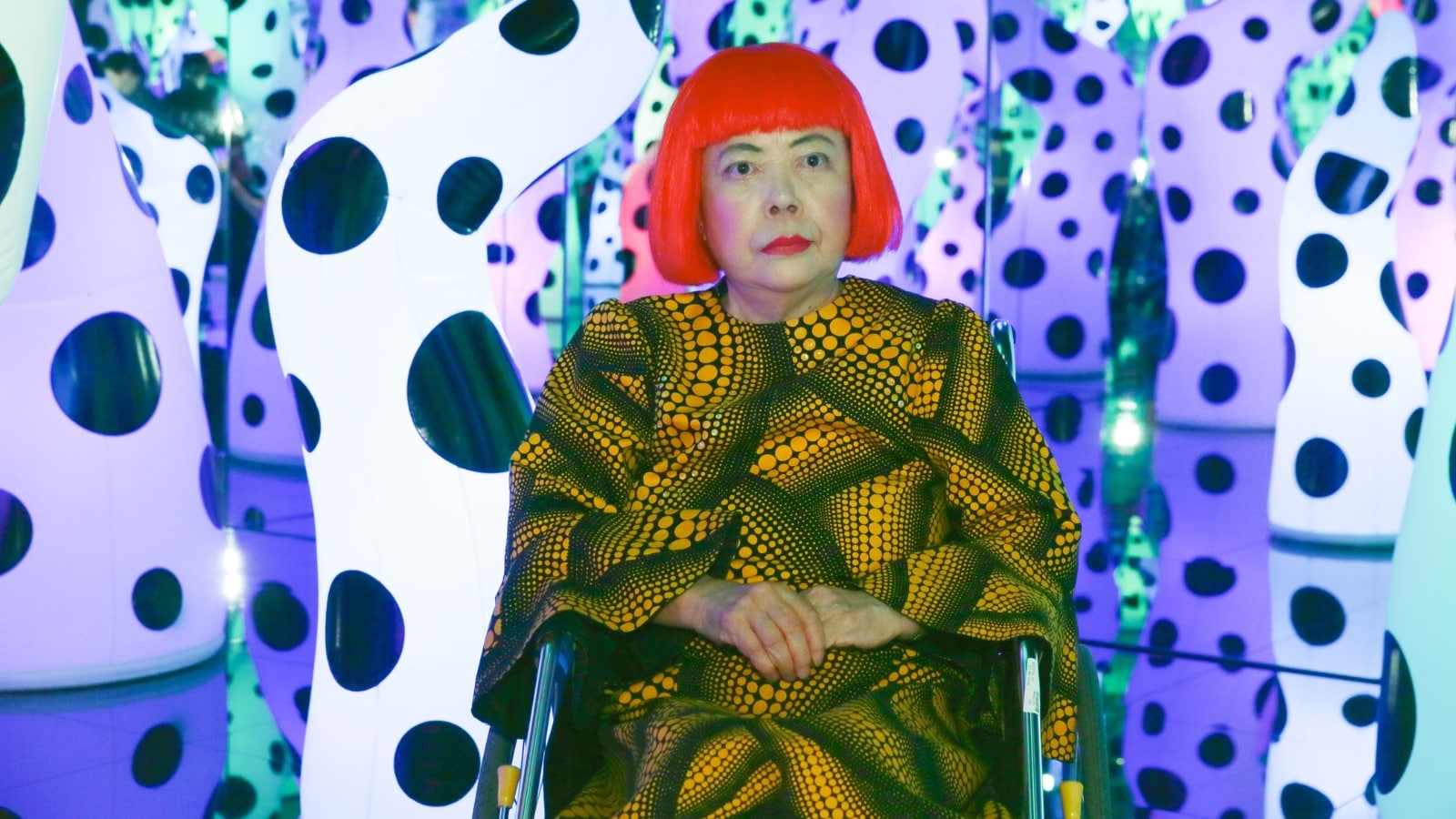
News from Tokyo confirms that the artist behind the world-famous polka dots has died. For decades, the public knew her through the vibrant snapshots: a petite figure with a blunt, fiery red bob, wearing clothes plastered in bold, hypnotic spots, standing beside giant, yellow pumpkins speckled with black ink. Instagram feeds were flooded with her mirrored sanctuaries. Visitors waited hours in lines that wrapped around city blocks just to spend forty-five seconds inside her luminous chambers, capturing the ultimate selfie of endlessness. To understand the complete picture, we recommend the recent report by Associated Press.
Yet, that glossy, modern spectacle tells only a fraction of the story. Beneath the pop-culture phenomenon and the blockbuster museum tickets lay a life forged in survival, psychiatric wards, and an absolute, unyielding obsession with escape.
The Roots of the Spots
Long before the world sought out her mirrored rooms for a fleeting escape from reality, a young girl in Matsumoto, Japan, was trying to escape her own mind.
It started in the greenhouses of her family’s seed nursery. Little Yayoi, growing up during the harrowing years of the Second World War, experienced severe visual and auditory hallucinations. Flowers would speak to her. The patterns on a red tablecloth would detach themselves from the fabric, crawl up the walls, and cover the ceiling. To a child, it was terrifying. The world was dissolving, choking her, swallowing her whole.
So, she picked up a pencil.
She began to draw the hallucinations, covering entire sheets of paper with dense, repetitive nets and dots. It was an act of containment. If she could draw the chaos, if she could trap the infinite visions on paper, perhaps they would stop eating her alive.
(To use a metaphor: her art was never a decoration; it was a life raft. While other artists painted what they saw, Kusama painted what was trying to destroy her, neutralizing the terror by multiplying it.)
When she left post-war Japan for New York City in 1957, she arrived with little money, wearing a kimono she had packed with thousands of dollars sewn into the lining, and a suitcase stuffed with her obsessive drawings. New York was loud, sprawling, and fiercely indifferent. Abstract Expressionism reigned, dominated by men with strong jaws and heavy brushstrokes. Kusama was an Asian woman in a foreign land, speaking broken English, struggling against a system that preferred its female artists quiet and decorative.
She did not stay quiet.
The Art of Self-Obliteration
In the streets of Manhattan, Kusama staged happenings. She painted polka dots onto naked protesters in Central Park to protest the Vietnam War. She arranged sculptures covered in soft, white phallic protrusions. She floated a thousand silver spheres on a lawn at the Venice Biennale in 1966, selling them to passersby for two dollars each, a stinging critique of the commercialization of art.
She called this process infinitude and self-obliteration. By covering everything—furniture, canvas, bodies, her own hands—in endless networks of dots, the ego dissolved. You ceased to be an isolated, lonely individual trapped in a fragile body. You became part of the cosmos.
The art world watched, fascinated and unsettled. Many of her male contemporaries—artists like Andy Warhol and Claes Oldenburg—borrowed heavily from her innovations, achieving immense fame and wealth while Kusama fought constantly to pay rent and buy paint.
Exhausted, broke, and suffering from worsening health, she returned to Tokyo in 1973. Many assumed her story had ended there, relegated to a footnote in art history books.
They were wrong.
Choosing the Hospital
In 1977, Kusama checked herself voluntarily into a mental hospital in Tokyo’s Shinjuku ward. She has lived there ever since.
Every morning, she walks from her psychiatric facility to her nearby studio, accompanied by assistants. She paints all day, surrounded by canvases that pulse with vibrant reds, yellows, and blacks, before returning to the hospital by nightfall.
Consider what that routine represents. For over four decades, one of the most famous living artists on the planet has lived a life split between a hospital room and a studio. She turned her sanctuary of healing into her permanent anchor. She did not hide her mental illness; she weaponized her lived experience against the darkness, transforming the very engine of her suffering into joy for millions.
When the global art market finally caught up with her in the late 1990s and 2000s, Kusama was already in her seventies. Suddenly, museums could not build large enough galleries to hold her work. Tickets sold out in seconds. Millions of people who had never set foot in an art museum stood in line for hours to experience her universe of light and dots.
Why did we fall in love with her dots?
Because we are all, in our own quiet ways, looking for a way out of our isolation. Modern life is fragmented, fast, and often deeply lonely. When a person steps inside an infinity room, the walls disappear. The ego is momentarily erased. For forty-five seconds, you are no longer just an employee, a debtor, a worried soul navigating a chaotic planet. You are light. You are reflection. You are infinite.
The Final Canvas
Now, the brush has stopped.
The red hair remains frozen in our collective memory, framed against a backdrop of glowing yellow pumpkins and endless mirrors. The galleries in New York, London, Tokyo, and Paris will host retrospectives, and visitors will still line up, whispering in hushed tones as they step into the dark enclosures.
They will look at the lights stretching out into the dark. They will see themselves multiplied into the thousands.
And somewhere in the quiet hum of those glowing diodes, the spirit of a little girl in Matsumoto, sitting among the seeds and the phantom flowers, will still be painting the edges of the universe, ensuring that we never feel entirely alone in the dark.