He had saved for four years to buy the tickets.
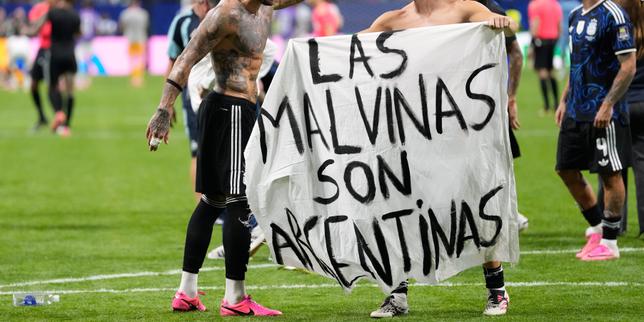
Mateo sat on the edge of a plastic cot in a cramped Queens apartment, holding two pieces of glossy paper that felt less like admission passes and more like holy relics. On Sunday, July 19, 2026, the MetLife Stadium in East Rutherford was supposed to host the coronation: Spain versus Argentina. The ultimate World Cup final. He was going to take his ten-year-old daughter, Sofia, to see the game she had spent her childhood playing on the gravel pitches of Astoria.
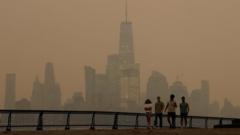
But when Mateo looked out the kitchen window on Thursday morning, the Manhattan skyline was gone.
In its place was a heavy, suffocating drape of copper-colored haze. The sun, usually a searing white July orb, looked like a dull, bloody coin. The air smelled faintly of burnt pine and plastic. He took a breath and felt a sharp, dry tickle at the back of his throat.
A hundred miles away, an automated monitor on a rooftop registered a number: 200.
To the bureaucrats at the New York State Department of Environmental Conservation, that number is a metric on a spreadsheet, the peak of an official Air Quality Health Advisory. But to a father whose daughter has mild asthma, that number is a threat. It is the sound of a rescue inhaler clicking in the middle of the night.
The Drifting Threat
The smoke doesn’t care about borders, and it certainly doesn't care about soccer.
Thousands of miles to the north, deep in the dry boreal forests of Ontario, Canada, the earth is burning. It has been burning for weeks. Millions of metric tons of carbon, soil, and ancient pine are being converted into an airborne ghost. Carried by a sweeping atmospheric current, this particulate matter has traveled south, settling over the most densely populated corridor in North America.
This isn't ordinary dust. The pollutant of concern is PM2.5—particles so microscopic that thirty of them could line up across the width of a single human hair.
When you inhale PM2.5, your body’s natural defense systems—the hairs in your nose, the mucus in your throat—are useless. The particles are too small. They slip past the physical barriers, travel deep into the alveoli of your lungs, and cross directly into your bloodstream. From there, they trigger a systemic inflammatory response. Your blood vessels constrict. Your heart pumps harder.
Under normal circumstances, an AQI of 200 is a signal to stay indoors with an air purifier running. But MetLife Stadium is an open-air coliseum. It has no roof. It has no giant filtration system to scrub the sky clean. For ninety minutes—potentially two hours or more if the game goes to extra time—eighty thousand spectators and twenty-two world-class athletes will be locked in a bowl of concentrated, toxic haze.
Consider the physical reality of a midfielder in a World Cup final.
During a standard match, a professional player runs upward of seven miles. Their respiration rate increases tenfold. They are not breathing gently through their noses; they are gulping air through their mouths, bypassing whatever minor filtration their nasal passages might offer. Inhaling air at an AQI of 200 under maximum athletic exertion is the physiological equivalent of smoking several cigarettes while sprinting a marathon.
The heart, already working at near-maximum capacity due to the intense summer heat wave gripping the Northeast, must battle on two fronts. It must pump oxygen to screaming muscles while simultaneously managing the systemic inflammation caused by the foreign particles invading the blood.
The Precedent in the Air
We have been warned about this before.
Just days ago, Toronto officials were forced to shut down their public Fan Festival after the city’s air quality index spiked, briefly earning it the grim title of the most polluted air on the planet. That wasn't a drill. It was a stark, modern reality: the climate is redrawing the rules of our public life.
New York Governor Kathy Hochul and local health commissioners have urged residents to limit outdoor exposure. High-quality N95 masks, once the symbol of a pandemic, are back on the streets, worn by commuters stepping off the subway into a yellow fog.
Yet, the momentum of a multi-billion-dollar global tournament is a powerful thing. Millions of fans have descended upon the city. Broadcast trucks are wired. Advertisers have paid their premiums. To cancel or postpone a World Cup final is an administrative nightmare of historical proportions.
But the air is a stubborn opponent. It cannot be bought off, negotiated with, or scheduled around.
Mateo looked down at his daughter, who was sitting on the floor, kicking a miniature soccer ball against the baseboard.
"Is it still happening, Papa?" she asked, her eyes bright with the uncomplicated optimism of childhood.
He didn't know what to tell her. He thought of the stadium, the roar of the crowd, the chance to see history made. Then he thought of the dry, rattling cough she gets every October when the damp air sets in. He thought of the heavy, hot air waiting for them in New Jersey.
The beautiful game has always been a celebration of what the human body can achieve—the limits of speed, endurance, and grace. But on Sunday, those bodies will be performing inside an invisible cage. Every cheer from the stands, every gasp from a tired player, will carry with it a tiny, toxic fragment of a burning northern forest.
The stadium lights will cut through the yellow haze, creating long, dramatic beams of amber light on the pitch. It will look beautiful on television. But on the ground, the true struggle won't just be between Spain and Argentina. It will be the quiet, desperate battle for a clean breath.