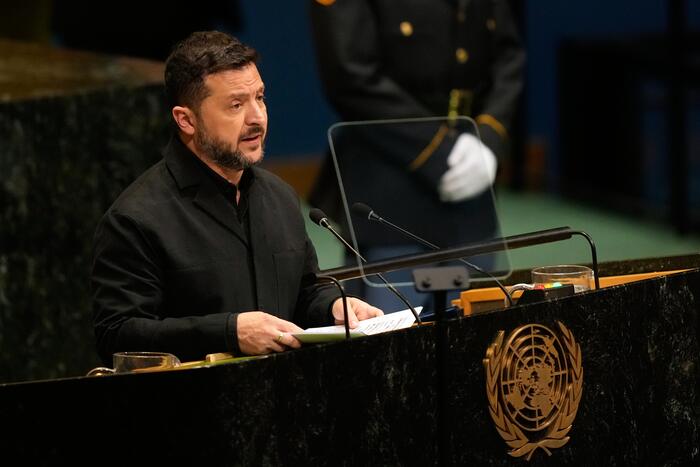
Most people assume ending the war in Ukraine comes down to a simple three-way standoff between Kyiv, Moscow, and Washington. That assumption is completely wrong. Ukrainian President Volodymyr Zelenskyy recently made headlines by revealing he directly urged Donald Trump to enlist China's help in forcing Russia to end its invasion.
On the surface, this sounds contradictory. Why would Ukraine ask a U.S. leader—who has frequently clashed with Beijing over trade and tariffs—to team up with Xi Jinping?
The answer is pure geopolitical pragmatism. Neither Washington nor Brussels holds the economic leash on Vladimir Putin anymore. Beijing does. If you want to understand where diplomacy around the Russia-Ukraine war is actually heading, you have to look past the usual Western talking points and examine the quiet triangle forming between Kyiv, Washington, and Beijing.
What Zelenskyy Actually Told Trump About China
Zelenskyy didn't just make a passing remark to reporters. He confirmed that during his direct conversations with Trump, he explicitly pushed the idea that China possesses unique pressure points over Moscow that the United States simply lacks.
Think about how sanctions have played out since February 2022. Western nations threw everything they had at the Russian economy—freezing central bank assets, cutting banks off from SWIFT, and slapping price caps on Russian oil. Moscow survived because Beijing stepped in as an economic lifeline. China became the primary buyer of discounted Russian crude and the main supplier of dual-use microelectronics keeping Russian missile factories running.
Zelenskyy knows this. When he spoke with Trump, his core argument was straightforward. Russia cannot sustain its war machine without Chinese economic backing. Therefore, any serious peace framework engineered by the White House has to involve bringing Xi Jinping to the negotiating table—or at least convincing him to turn down the economic faucet feeding the Kremlin.
It's a calculated gamble from Kyiv. For years, Ukrainian officials watched China promote a 12-point "peace plan" that largely echoed Russian talking points and skipped Ukrainian peace summits in Switzerland. Yet Zelenskyy recognizes that ignoring Beijing guarantees a stalemate. By pitching China's involvement directly to Trump, Zelenskyy is trying to align his survival strategy with Trump's well-known desire to broker a massive, high-profile diplomatic deal.
Why Beijing Holds the Real Keys to Moscow's Economy
If you look closely at the trade numbers between Moscow and Beijing, the power dynamic isn't a partnership of equals. It's a dependency. Before 2022, Putin liked to project strength alongside Xi Jinping, calling their relationship a "no limits" friendship. Today, Russia acts far more like a junior resource supplier to China's massive industrial base.
Consider the energy sector alone. When Europe stopped buying Russian pipeline gas and seaborne oil, Moscow had nowhere else to go. China absorbed that supply at steep discounts, saving the Kremlin from immediate fiscal collapse while securing cheap energy for its own factories.
Then there's the currency shift. The Chinese yuan has effectively replaced the U.S. dollar and the euro as the dominant foreign currency traded on the Moscow Exchange. Russian businesses rely on Chinese banks to settle international transactions, and Russian consumers buy Chinese cars, smartphones, and heavy machinery where Western brands used to sit.
Here is why that matters for diplomacy:
- Financial vulnerability Whenever Washington threatens secondary sanctions against Chinese banks facilitating Russian defense trade, those banks immediately freeze payments to Russian importers. Beijing cares infinitely more about access to American and European consumer markets than it does about propping up Putin's territorial ambitions.
- Technological choke points Russia's military-industrial complex depends on Chinese machine tools, optics, and commercial drone components. Beijing doesn't even need to join Western sanctions to cripple Russia's offensive capacity; it just needs to strictly enforce its own existing export controls.
- Diplomatic cover Putin relies on China at the United Nations Security Council and within blocs like BRICS to prove Russia isn't globally isolated. If Beijing signals impatience with the war, Putin loses his most valuable international shield.
Zelenskyy isn't asking China to suddenly become an ally of Ukraine. He's asking Trump to use American economic power to make supporting Russia too expensive for Beijing.
The Friction Between Washington's China Policy and Ukraine Aid
Here is where the strategy gets messy. Asking Trump to enlist China's help runs headfirst into decades of entrenched Washington orthodoxy—and Trump's own aggressive trade agenda.
In American politics, China is almost universally viewed as the primary long-term strategic adversary. Both Democrats and Republicans spent years framing Russia and China as part of a single authoritarian axis. Under that worldview, you don't ask Beijing to help solve a European security crisis because doing so legitimizes Chinese influence in Europe and gives Xi Jinping diplomatic standing he hasn't earned.
Trump, however, operates differently than traditional foreign policy establishments. He views international relations through bilateral deals and personal rapport with strongmen. While he has repeatedly threatened sweeping tariffs on Chinese imports, he has also boasted about his relationship with Xi Jinping and argued that he could end the war in Ukraine quickly through direct negotiations.
Zelenskyy is clearly reading the room. He understands that telling Trump to "stay the course" with endless billion-dollar aid packages won't resonate the way it did with the Biden administration. Instead, Zelenskyy is framing the conflict in terms Trump understands—power, transactional diplomacy, and making Beijing pay a price for enabling chaos.
Still, there is a massive risk here for Kyiv. What happens if Trump and Xi actually strike a grand bargain? Beijing would never pressure Putin for free. Xi Jinping would almost certainly demand concessions from Washington in return—perhaps rolling back tariffs, easing restrictions on advanced semiconductor exports, or softening U.S. rhetoric regarding Taiwan. Nobody in Kyiv wants Ukraine's sovereignty traded away as a bargaining chip in a U.S.-China trade deal, yet inviting Beijing into the room inevitably puts those issues on the table.
What Most Commentators Miss About China's Actual Motives
Whenever China's role in the Ukraine war comes up on cable news, pundits usually fall into two camps. One side claims Xi Jinping wants the war to drag on forever because it drains American weapons stockpiles and distracts Washington from the Indo-Pacific. The other side insists China wants immediate peace so global trade can stabilize.
Both takes miss the nuance of Beijing's actual headache.
At the start of the invasion in 2022, a quick Russian victory would have suited Beijing just fine. It would have humiliated NATO and exposed Western weakness. Instead, Putin got bogged down in a brutal war of attrition that accomplished the exact opposite of what China wanted. It revitalized NATO, pushed Finland and Sweden into the alliance, and forced European nations to sharply increase their defense spending.
Worse yet for Beijing, the war damaged China's crucial trade relationship with the European Union. European leaders who previously resisted American pressure to decouple from Chinese tech and supply chains suddenly hardened their stance once they saw Beijing backing Putin's invasion on European soil. For an export-driven Chinese economy grappling with a severe real estate crisis and sluggish domestic growth, alienating wealthy European customers is a serious problem.
China also has genuine anxiety about nuclear escalation. Putin's repeated nuclear saber-rattling violates long-standing Chinese nuclear doctrine and threatens global stability in ways that hurt Beijing's economic interests. Xi Jinping has reportedly warned Putin directly against using nuclear weapons in Ukraine.
So China isn't unconditionally committed to Russia's war effort. Beijing wants Russia to survive as a stable, anti-Western buffer state, not collapse into chaos. At the same time, Beijing has zero interest in going down with Putin's ship if the economic costs escalate.
How a Three-Way Diplomatic Push Could Actually Work
If Trump decides to act on Zelenskyy's pitch, it won't look like a traditional peace conference with diplomats drafting polite communiqués in Geneva. It will look like hardball economic coercion paired with backchannel diplomacy.
First, Washington would need to tighten the screws on secondary sanctions. Right now, enforcement against Chinese entities aiding Russia's military has been incremental—targeted warnings here, specific corporate blacklists there. To force Beijing's hand, the White House would have to threaten major Chinese state-owned banks with exclusion from the U.S. financial system unless they sever ties with Russian defense and energy firms.
Second, Trump would likely link trade relief directly to cooperation on Ukraine. Beijing desperately wants relief from American tariffs and tech restrictions. Offering a pause on new tariffs in exchange for verifiable Chinese pressure on Moscow to accept a ceasefire gives Xi Jinping a tangible incentive to step in.
Third, China would have to offer Putin an off-ramp that doesn't look like total surrender. Putin cannot accept a ceasefire dictated by Washington or NATO without looking weak at home. He can accept a ceasefire framed as a response to a joint peace initiative led by his "dear friend" Xi Jinping and backed by major Global South nations. That gives the Kremlin a face-saving narrative while freezing the front lines.
Common Misconceptions About Ending the War Through Beijing
People often oversimplify what happens if China steps into the peace process. Clearing up a few persistent myths helps show how fragile this path really is.
- Myth 1 China can simply order Putin to withdraw troops. Putin views Ukraine as an existential issue tied to his personal legacy and regime survival. Even Xi Jinping cannot force Russia to abandon Crimea or completely capitulate without risking a political breakdown in Moscow that Beijing wants to avoid. China can pressure Russia into a ceasefire or a frozen conflict, not a total retreat.
- Myth 2 Zelenskyy's outreach means Ukraine is ready to cede territory. Urging Trump to involve China doesn't mean Kyiv has given up on its sovereignty. Zelenskyy is trying to ensure that if negotiations happen, Russia enters them from a position of economic weakness rather than backed by unlimited Chinese support.
- Myth 3 Europe will blindly follow a U.S.-China deal. European leaders have poured tens of billions of euros into Ukraine's defense and economy. Any peace arrangement brokered between Washington and Beijing that leaves Ukraine defenseless or rewards Russian aggression will face fierce resistance from Paris, Berlin, Warsaw, and London.
What to Watch Next in the Kyiv-Washington-Beijing Triangle
You don't need insider access to classified diplomatic cables to track whether Zelenskyy's strategy is gaining traction. Watch three concrete indicators over the coming months.
First, keep an eye on U.S. Treasury Department sanction announcements targeting Chinese financial institutions and tech exporters. If Washington suddenly ramps up penalties on major Chinese banks rather than small shell companies, it signals the White House is actively building leverage to force Beijing into negotiations.
Second, watch high-level diplomatic travel between Beijing, Kyiv, and Washington. Look closely at whether China's special envoy for Eurasian affairs begins holding substantive meetings with Ukrainian officials alongside U.S. counterparts, rather than sticking strictly to Moscow's talking points.
Third, monitor rhetoric around tariffs and trade talks between Trump and Xi Jinping. If discussions about Ukraine start appearing alongside announcements regarding U.S.-China trade delegations, you'll know Kyiv's message landed—and that the road to ending Europe's largest war since World War II now runs straight through Beijing.