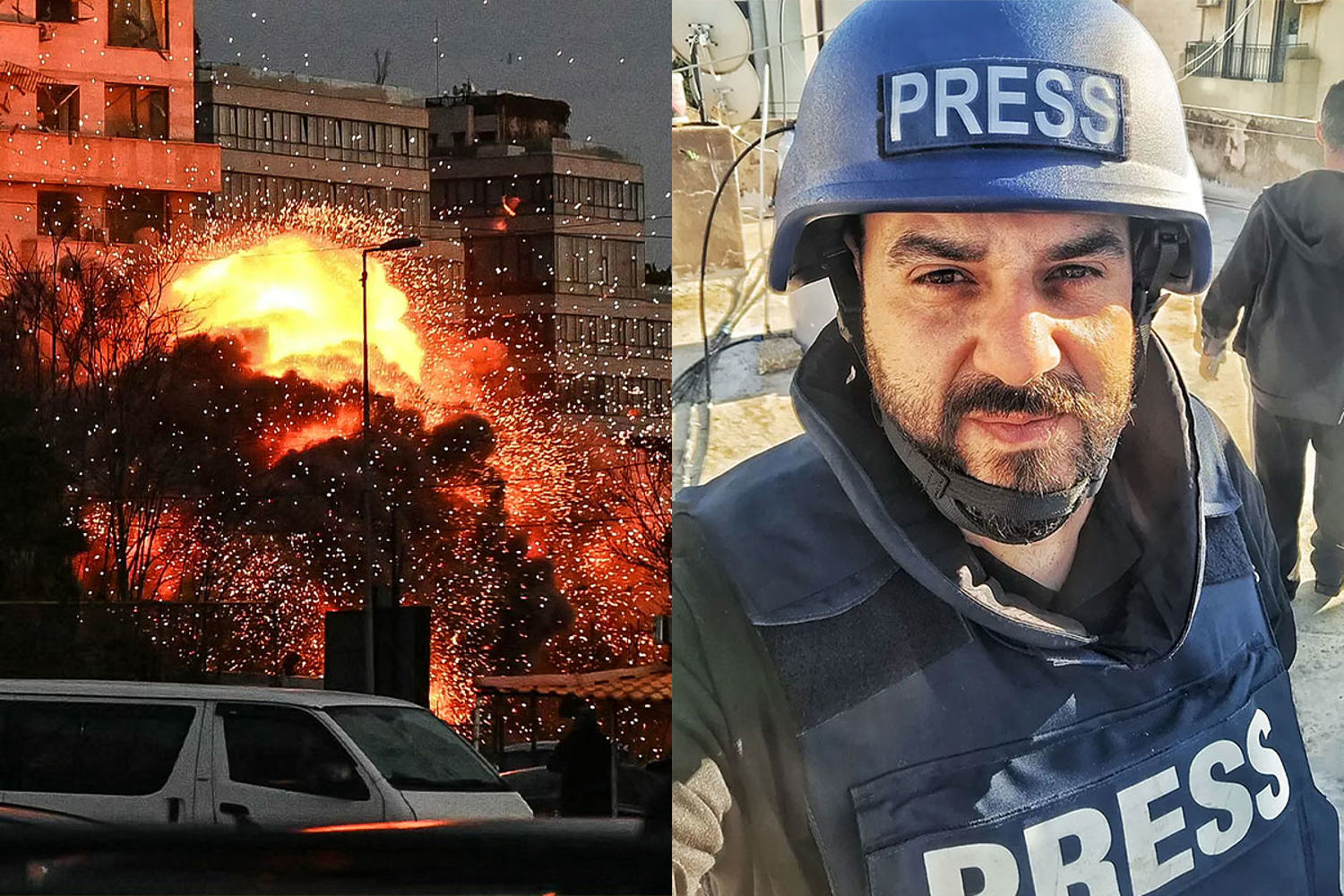
The flash isn't from a camera. It’s a thermobaric signature or a secondary explosion ripping through a residential block in Dahiyeh. While most people are sprinting toward the mountains or huddled in basements, a handful of photographers are driving the other way. They aren’t there for the adrenaline. They’re there because if they don't document the precise moment a missile meets a high-rise, the world will argue about whether it actually happened.
Photography in a war zone like Lebanon today isn't just about art. It’s about forensic proof. When you see a Beirut photographer puts himself in the firing line to capture Israeli strikes, you aren't just looking at a brave guy with a Leica. You’re looking at someone providing the only real-time accountability left in a region where narratives are weaponized faster than the munitions themselves. Also making headlines in this space: Finland Is Not Keeping Calm And The West Is Misreading The Silence.
The Brutal Reality of the Shot
Taking a photo in Beirut right now is a math problem with lethal consequences. You have to calculate the distance of the drone buzz, the "warning" strikes that often precede a collapse, and the time it takes to swap a memory card. Hassan Ammar and other veterans on the ground aren't guessing. They’re using years of muscle memory to stay alive.
Most people think these shots are lucky. They aren't. They’re the result of standing on a balcony or a street corner for six hours in the humidity, waiting for the sky to break. You’re tracking the sound of the jet. You’re watching the birds. If the pigeons suddenly scatter, you know the pressure wave is coming. More details on this are detailed by USA Today.
It’s a grim business. You’re essentially waiting for someone’s home to turn into dust. But if you blink, the strike is over. The dust settles, the cloud rises, and the specific detail of the weapon used is lost to the rubble. These photographers are capturing the "before" and "after" in a single frame. That’s the only way to show the scale of what's being lost.
Why Distance is a Lie
In modern conflict, there’s a push toward remote sensing. Satellites and drones provide a top-down view that feels clean and clinical. It looks like a video game. But that view misses the human cost. It misses the way the air tastes like pulverized concrete after a strike.
A ground-level photographer changes the perspective. When a lens is pointed up from the street, you see the laundry hanging on the balcony next door. You see the grocery store that was open ten minutes ago. This ground-up view destroys the "surgical strike" myth. It shows the mess. It shows the jagged glass and the shredded trees.
I’ve seen how these images circulate. Within seconds of being uploaded to wires like the AP or Getty, they’re being analyzed by OSINT (Open Source Intelligence) researchers. They’re looking at the tail fins of the missiles or the angle of the collapse. Without that guy standing in the "red zone," that data wouldn't exist.
The Mental Tax of the Firing Line
We don't talk enough about what happens to the person behind the viewfinder. You’re looking at a tragedy through a 70-200mm lens. It creates a weird sense of detachment. It’s a glass shield. But that shield is thin.
When the camera comes down, the reality hits. Many Beirut photographers are covering their own neighborhoods. They’re filming the destruction of the streets where they bought coffee or took their kids to school. It’s a double trauma. You’re a professional observer and a victim at the same time.
Equipment and Survival
If you’re wondering what it takes to get these shots, it’s not just a fancy camera. It’s a kit built for a nightmare.
- Ceramic Plates: Most photographers are wearing Level IV body armor. It’s heavy. It makes you slow. But it’s the difference between a shrapnel wound and a funeral.
- The Helmet: Usually blue, usually marked "PRESS." In theory, it’s a "don't shoot" sign. In practice, it’s just a target for some.
- Fast Glass: You need lenses with wide apertures. Strikes often happen at dusk or night. You need to pull in every bit of light without blurring the motion of the missile.
- Multiple Bodies: You don't have time to change lenses. You carry two or three cameras strapped to your chest. One for the wide shot, one for the tight detail.
The gear is secondary to the instinct. You learn to read the "double tap." That’s when a second strike hits the same spot to catch the first responders and journalists. If you stay too long to get the "perfect" shot of the smoke, you might not make it out for the next one.
The Fight Against Disinformation
We live in an age of AI-generated images and deepfakes. This makes the physical presence of a human photographer even more vital. A digital file from a trusted photojournalist contains metadata. It has a GPS stamp. It has a timestamp.
When a strike happens in a dense urban area like Beirut, the first thing that happens online is a war of words. One side says it was a munitions depot. The other says it was a school. The photographer provides the raw evidence. They show the secondary explosions—or the lack thereof. They show the civilian casualties before the site is cleaned up or cordoned off.
Honestly, it’s the most dangerous job in the world right now because the "truth" is an enemy to so many players. Journalists aren't just accidental victims; they’re often seen as participants in the information war. Every time a photographer presses the shutter, they’re taking a side—the side of the record.
The Role of Local Stringers
While big international names get the headlines, the local Lebanese stringers do the heavy lifting. They know the back alleys. They know which rooftops are stable and which ones will crumble if a bomb hits three blocks away. They’re the ones who stay when the foreign correspondents get pulled out by their editors for being too "high risk."
These locals are the backbone of global news. They’re risking their lives for a day rate that wouldn't cover a fancy dinner in London or New York. They do it because it’s their city. If they don't tell the story, nobody will.
How to Support Real Journalism
The next time you scroll past a photo of a fireball over Beirut, don't just look at the explosion. Look at the credit line. See who took it. Understand that a human being had to stand in a specific spot, at a specific second, knowing they might be blown to bits, just so you could see that image.
Stop relying on grainy, unverified Telegram clips. Seek out the work of professional photojournalists who adhere to ethical standards. Support outlets that still pay for boots on the ground. The cost of a subscription is nothing compared to the price these photographers pay to keep the world's eyes open.
Verify the source before you share. If an image looks too "perfect," check the metadata or look for the photographer's name. Real war photography is often messy, obscured by dust, and framed in a hurry. That’s how you know it’s real. That’s how you know someone was actually there, breathing in the smoke, holding the line.