Elena remembers the silence of 2014. She was in a border town, looking at a map that seemed permanent, inked in the blood and ink of centuries. Then the news came. The maps were being redrawn by force. That night, she didn't sleep. She watched the horizon, wondering if the promises made by distant allies would actually materialize if the tanks started rolling toward her village. They didn't. Not really. She realized then that security is not a contract; it is a physical capacity to hold a line.
Today, Madrid is looking at that same map. Spain is not whispering about an European Union army anymore; it is beginning to shout. They see the same fraying edges that Elena saw. They see a continent that has spent decades acting like a wealthy homeowner who forgot to install locks because the neighborhood felt safe for a few generations.
The proposal is simple on paper. A standing, permanent, interoperable force that answers to Brussels, not just to individual capitals. It sounds logical. It sounds efficient. But underneath that bureaucratic veneer, it is an admission of failure. We have spent seventy years pretending that economic integration—trading steel, coal, and digital services—is a substitute for the ability to project power.
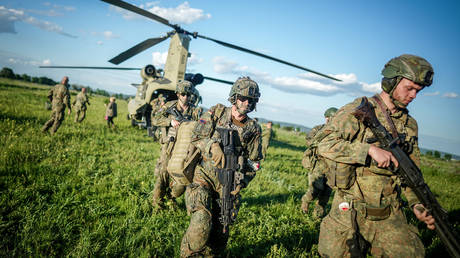
Consider the reality of a single patrol in the Baltics. Right now, if a crisis erupts, the response is a disjointed mosaic of national loyalties, varying ammunition calibers, and linguistic barriers. It is a nightmare of logistics. Imagine a mechanic trying to fix a jet engine while the manual is written in three different languages and the tools provided by the supplier don't fit the bolts. That is the current state of European defense.
Spain’s push for a unified army is a cold glass of water to the face of a sleepy continent. Madrid realizes that relying on the United States is no longer a permanent strategic insurance policy. When the wind shifts in Washington, the entire security architecture of Europe creaks. The Spanish government is essentially asking a uncomfortable question: What happens when the neighbor across the ocean decides he is tired of paying for our fence?
This is where the abstractions turn into human consequences. To build this army, you have to do more than sign papers. You have to dissolve the ego of the nation-state. You have to convince a French soldier that their command chain might run through a German strategic planning office, or that a Spanish logistics chain might prioritize an Italian front. History is a graveyard of coalitions that fell apart the moment the first shell hit the mud.
Think of the sheer scale of the investment. We are talking about trillions in procurement, unified command structures, and the inevitable loss of domestic defense industry prestige. If Spain buys a tank from a German manufacturer to standardize the fleet, a Spanish factory goes quiet. That is a job lost. That is a town in Extremadura wondering why their government sacrificed their livelihood for a dream of European unity that feels miles away.
Yet, the alternative is paralysis.
Look at the history of the last two decades. We have seen intervention in Libya, a slow-motion unraveling in the Sahel, and the return of total war on our eastern flank. In every instance, Europe arrived late, divided, and under-equipped. We are like a giant who refuses to acknowledge he has legs, hoping that if we just keep talking, the world will eventually agree to be peaceful.
But the world does not care about our treaties. It cares about gravity. And gravity pulls toward strength.
Spain’s proposal brings a specific, sharp edge to the table because of their unique geographic position. They guard the gates of the Mediterranean. They stare at North Africa, a region where instability is not a theoretical threat but a constant, pulsing reality. They understand that a border is only as strong as the person standing on it. They are not asking for a fancy EU parade force; they are asking for a sword that can be swung without waiting for the permission of twenty-seven different parliaments.
There is a fear, of course. It is the fear of the loss of sovereignty. Many in the eastern capitals, closer to the iron teeth of current conflicts, worry that a Brussels-led army would be too slow, too consensus-driven, or too hesitant to face the brutal reality of their specific dangers. They trust their own rifles. They trust their own borders. They look at a central command and see a screen, not a shield.
But look at the math of survival. A single nation in Europe today is a small boat in a hurricane. Together, we are an aircraft carrier. The friction of coordination is high, but the cost of going alone is absolute ruin.
We are reaching a point where the comfort of our post-Cold War sleep is coming to an end. The sirens are getting louder. We have lived in the luxury of being able to ignore the mechanics of violence, delegating it to others or pretending it was a relic of a darker age. But the age is not dark because we wanted it to be; it is dark because human ambition and territorial hunger never truly went away. They only went on hiatus while we were distracted by the screen in our pockets and the steady growth of our markets.
If this army comes to be, it will not happen because of a brilliant speech or a perfectly drafted resolution. It will happen because of a moment of sudden, terrifying clarity. It will be the moment a country realizes that when the lights go out, there is no one else to call.
Elena still checks the horizon. She knows that security is not a feeling. It is not a promise. It is the weight of steel, the reach of radar, and the terrifying, beautiful coordination of a thousand moving parts working as one. Madrid knows this too. They are holding up the mirror, forcing the rest of us to look at the reflection of a continent that has everything to lose and, for now, not enough iron to keep it.
The question is not whether the union can afford a standing army. The question is how much longer we can afford to pretend that we don't already need one. Every day we delay, the map gets a little more fragile, the ink a little more faded, and the silence on the border a little more heavy.
The wind is rising. We are still deciding if we will build the house to weather it, or if we will simply watch the roof blow away, convinced that the storm was never really coming for us.