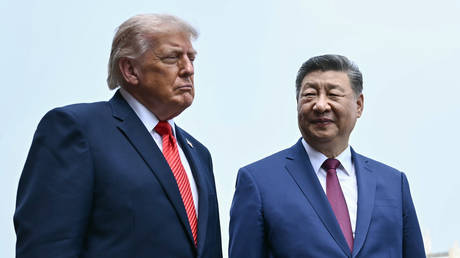
Power is a performance, and the stage is currently falling through the floor. For years, the political world watched a specific brand of dominance—the aggressive handshake, the sudden yank, the physical crowding of space—and mistook it for genuine geopolitical leverage. But the era of the physical bully in high-stakes diplomacy has hit a wall. When Donald Trump was reduced to a mere doorman in a fleeting, fifteen-second exchange, it wasn't just a lapse in social etiquette. It was a visual signal that the "Strongman" playbook has become a liability in a world that now values calculated restraint over theatrical aggression.
The shift happened in plain sight. We saw the transition from the bone-crushing grip that once defined Mar-a-Lago summits to a passive, almost subservient stance in the presence of more disciplined actors. This isn't about one man’s fatigue; it is about the fundamental failure of a specific type of performance art. When the handshake fails to intimidate, the entire facade of the "alpha" negotiator crumbles, leaving behind nothing but a politician waiting for instructions.
The Anatomy of the Power Play
The traditional strongman relies on physical cues to establish a hierarchy before a single word is spoken. You have seen it a thousand times. The "pat on the back" that is actually a shove. The hand-on-shoulder maneuver designed to make the other person look smaller. These are not gestures of friendship. They are tools of psychological warfare meant to trigger a submissive response in the opponent.
However, these tactics only work against those who agree to play the game. When a leader meets a counterpart who refuses to budge—or worse, someone who treats the aggression with bored indifference—the "strongman" suddenly looks desperate. The fifteen-second handshake that went nowhere is the perfect example. It was a vacuum where power used to be. Instead of the "big fat hug" or the aggressive pull-in, there was a mechanical coldness. The transition from the center of the room to the person holding the door is more than a change in position; it is a demotion in real-time.
Why the Handshake Matters
In diplomacy, the handshake is the smallest unit of a treaty. It is a non-verbal contract. When a leader who built an entire brand on being "the closer" or the "toughest guy in the room" is seen being moved around like furniture, the market reacts. Not just the stock market, but the market of international respect. Allies see a weakness they can exploit, and enemies see a target they no longer need to fear.
The failure of the physical power play stems from its predictability. In the early days, the aggressive yank caught world leaders off guard. They stumbled. They looked weak on camera. But the international community is a fast learner. Leaders began bracing their cores, planting their feet, and countering the pull with a steady, unyielding grip. Once the trick is known, it stops being a power move and starts being a gimmick.
The Mirage of Personal Chemistry
We have been sold the lie that personal chemistry between leaders drives history. It doesn't. Interests drive history. The idea that a "big fat hug" or a warm personal relationship can bypass the cold realities of national security or trade deficits is a fantasy sold to the public to make complex geopolitics feel like a soap opera.
When the hugs stop and the handshakes turn cold, it reveals the emptiness of that "chemistry." If the relationship was built on the ego of the strongman rather than the shared interests of the states, it disappears the moment the ego is bruised. We are seeing the fallout of a diplomacy based on moods rather than maps.
The Cost of Performance
The performance of strength is expensive. It requires constant escalation. To maintain the image, each meeting must be more "dominant" than the last. But there is a physical and political limit to how much you can bully a peer on the world stage. Eventually, you run out of room to grow, and the only direction left is down.
- Physical Fatigue: Maintaining a high-tension persona is exhausting for a leader in their late 70s.
- Diminishing Returns: The more you use a "power move," the less power it actually conveys.
- Institutional Pushback: Deep-state actors and career diplomats often work to undo the damage caused by a leader's impulsive physical outbursts.
The "doorman" moment is the inevitable end-point of this trajectory. It is the moment the performer realizes the audience is no longer intimidated, and the only thing left to do is play the part of the polite host while the real power shifts to another room.
The New Geopolitical Currency
If the physical strongman is a relic, what replaces him? We are entering an era of "Quiet Competence." The most effective leaders on the planet right now are not the ones making headlines for their handshakes. They are the ones who show up, say very little, and leave with exactly what they wanted.
http://googleusercontent.com/image_content/269
This new currency is built on predictability and technical expertise. In a world of high-volatility markets and shifting alliances, "predictable" is the new "strong." A leader who can be counted on to follow a script is more valuable to their country's long-term stability than one who tries to "win" a photo op through physical theater.
The Illusion of Control
Strongmen thrive on the illusion that they are the only ones in control. By making everything about their personal presence, they convince their base that without them, the system would collapse. But the fifteen-second handshake exposed the truth: the system moves on with or without the theater. The door is opened, the guest walks through, and the "strongman" is left standing on the outside, looking for the next camera.
The shift from a hug to a cold handshake is a signal to the base as well. It suggests that the "special relationship" or the "unique bond" was always a one-way street. When the partner in that bond decides the theater is no longer useful, they drop the act instantly. There is no loyalty in the world of strongman politics; there is only the current utility of the image.
Beyond the Photo Op
We need to stop analyzing summits based on the "vibe" and start looking at the mechanics of the exit. Who stayed in the room? Who was left holding the door? These are not just metaphors. In the rigid protocol of international diplomacy, every inch of movement is choreographed. If a leader ends up in the "doorman" position, it is because they were out-maneuvered in the pre-meeting negotiations.
The "Strongman to Doorman" pipeline is a warning to any political movement built entirely around a single personality. When that personality can no longer dominate the physical space, the movement loses its primary engine. It is a fragile way to run a country and an even more fragile way to conduct foreign policy.
The era of the "big fat hug" is over because the world has grown tired of the squeeze. We are moving toward a colder, more calculated form of interaction where the handshake is just a handshake, and the real work happens in the silence that follows. The theater has closed, and the performers are being told to move to the side of the stage.
The most dangerous thing for a bully isn't a punch; it is being treated as irrelevant. Holding the door for someone else isn't an act of kindness in this context; it is a public acknowledgment that you are no longer the one the world is waiting for. You are just the one making sure the real players can get into the room.
Stop looking at the grip and start looking at the eyes. The fire is gone, replaced by the blank stare of a man who realized too late that you can't shake your way into a legacy. The strength was always a thin veneer, and it has finally rubbed off.
Don't wait for the next "strongman" to save the day. They are too busy checking their reflection in the glass of the door they are holding open for their replacement.