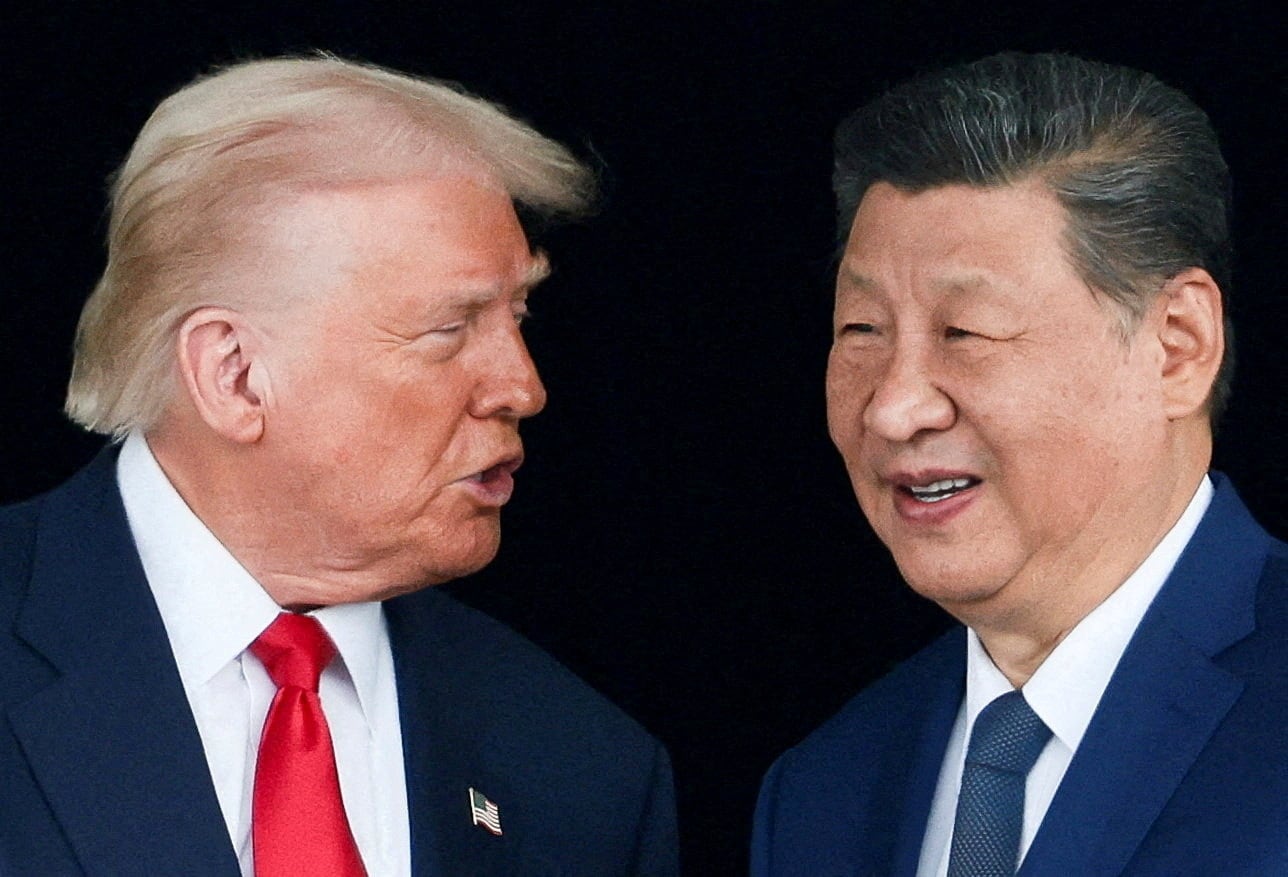
The refusal of Chinese President Xi Jinping to personally meet Donald Trump at the airport—delegating the task to Vice President Han Zheng instead—represents a calculated deployment of diplomatic asymmetry rather than a mere scheduling conflict. In the specialized architecture of statecraft, airport receptions serve as a high-visibility variable in the broader signaling equation. By downgrading the rank of the receiving official, Beijing utilizes "protocol friction" to communicate a recalibration of the bilateral power dynamic without resorting to explicit policy declarations. This maneuver exploits the gap between formal diplomatic requirements and the symbolic expectations of a returning or visiting head of state, creating a controlled environment for strategic cooling.
The Hierarchy of Presence and the Cost of Proximity
State visits operate on a strict tiering system where the rank of the greeter is the primary metric of respect. Under standard international norms, a head of state usually expects a peer-level greeting or, at minimum, a high-ranking cabinet official with a direct line to the executive. Don't forget to check out our earlier article on this related article.
The decision to send Vice President Han Zheng functions as a "Sub-Optimal Peer Match." While Han Zheng holds significant rank, he is not the ultimate decision-maker in the Chinese Communist Party (CCP) structure. This creates a functional buffer between Xi and Trump. The strategy serves three distinct operational objectives:
- Risk Mitigation: Physical proximity between two unpredictable leaders at an airport creates unscripted variables. By removing himself from the immediate tarmac arrival, Xi retains the "Last Word" advantage, forcing Trump to enter Chinese-controlled space without the immediate validation of a peer-level encounter.
- Status Leveling: If Trump perceives himself as a dominant geopolitical actor, Xi’s absence reasserts a "Host-Guest" hierarchy where the host dictates the terms of engagement. It is a subtle reminder that the schedule remains a Chinese prerogative.
- Domestic Signaling: For the internal Chinese audience, the presence of a Vice President suggests a professional, business-like relationship rather than a personal or tributary one. It frames the visit as an administrative necessity rather than a celebratory summit.
The Protocol Logic of "Reciprocity Deviance"
Diplomacy relies on the principle of reciprocity—the expectation that Treatment A in Country X will be met with Treatment A in Country Y. When one party deviates from this, it creates a "Diplomatic Deficit." To read more about the context of this, Reuters offers an informative breakdown.
During previous engagements, specifically the Mar-a-Lago summit and subsequent state visits, the level of pageantry was a point of contention. Beijing’s shift toward a lower-ranking reception is a response to perceived volatility in U.S. trade and security policy. In this context, the airport greeting becomes a "low-cost signal." It costs Beijing nothing in terms of actual policy concessions to send a lower-ranking official, yet it signals dissatisfaction with an intensity that is immediately understood by State Department analysts.
The mechanism at work is Managed Ambiguity. By sending Han Zheng, Beijing avoids a total snub—which would involve a low-level bureaucrat—but denies the "Full Honors" that would signify a breakthrough in relations. This middle-path strategy keeps the U.S. delegation off-balance, forcing them to determine whether the slight is personal, systemic, or purely logistical.
Categorizing the Three Pillars of Chinese Diplomatic Signaling
To understand why this specific maneuver was chosen, we must look at the three pillars that govern the CCP’s external signaling framework:
The Pillar of Sovereign Dignity
China’s "Century of Humiliation" informs every modern protocol decision. The leadership is hyper-sensitive to any optics that suggest China is overly eager to please a Western power. Meeting a U.S. leader on the tarmac is increasingly viewed as an unnecessary concession. By waiting at the Great Hall of the People or a secondary location, Xi adheres to the "Imperial Center" model, where the visitor travels to the seat of power rather than the power meeting the visitor at the gate.
The Pillar of Incrementalism
Chinese strategy favors incremental adjustments over sudden pivots. A change in airport protocol is an incremental downgrade. It serves as a warning shot. If trade negotiations or security dialogues fail to meet Beijing’s benchmarks, the next interaction may see a further reduction in ceremonial honors. Conversely, if concessions are made, the "Peer Greeting" can be restored as a reward.
The Pillar of Institutional Buffering
Using Han Zheng creates a layer of "plausible deniability." If the U.S. complains about the lack of a presidential greeting, Beijing can point to Han’s seniority and a "busy executive schedule" as a neutral explanation. This forces the U.S. into the uncomfortable position of complaining about etiquette, which can be framed as petty or insecure, while the underlying policy tension remains unaddressed.
The Cost Function of Symbolic Snubs
While these maneuvers are effective in the short term for signaling, they carry an inherent "Friction Cost." Diplomatic friction functions much like mechanical friction: it generates heat and slows momentum.
- Information Asymmetry: When the U.S. delegation arrives to a lower-ranked greeter, it immediately shifts the focus of the initial briefing from policy to "reading the room." This consumes cognitive bandwidth and can lead to defensive negotiation stances.
- Media Amplification: In the age of 24-hour news cycles, the image of a Vice President meeting a President is a headline-ready data point. It provides ammunition for domestic critics of the U.S. administration, labeling the trip a failure before it has officially begun.
- The Precedent Trap: Once a lower standard of reception is established, it becomes the new baseline. Restoring the previous level of honors then requires a "payment" in the form of a policy win, effectively making protocol a commodity that can be traded.
Quantitative Mapping of Diplomatic Rank in Receptions
We can model the "Greeting Impact" ($G$) as a function of the Rank of the Greeter ($R$) and the Historical Context ($C$).
$$G = (R_{host} / R_{guest}) \times C_{stability}$$
Where $R$ is a numerical value assigned to the hierarchy (Head of State = 1.0, Vice President = 0.7, Foreign Minister = 0.5). If $G$ falls below 1.0, the visit is quantitatively defined as a "downgrade." In this specific instance, the $0.7$ value assigned to Han Zheng, multiplied by a low stability coefficient ($C$) due to ongoing trade wars, results in a reception score that signals a "Transactional" rather than "Strategic" partnership.
This model explains why the U.S. side cannot simply ignore the gesture. It is a measurable reduction in the quality of the diplomatic environment.
The Role of Han Zheng: Strategic Utility vs. Personal Stature
Han Zheng is not a random selection. As a former Mayor of Shanghai and a member of the Politburo Standing Committee, he represents the "Technocratic Elite." His presence suggests that China views the relationship through a lens of economic management and urban stability rather than high-level ideological alignment.
By utilizing Han Zheng, Xi Jinping accomplishes a "De-escalation of Persona." The meeting is stripped of the "Xi-Trump" personality cult dynamics and is instead relegated to the realm of high-level administration. This is a tactical move to neutralize the "personal chemistry" that Trump often attempts to leverage in negotiations. It is difficult to build a rapport based on personal flattery when the person you are meeting is a deputy tasked with maintaining a script.
The Bottleneck of Personalist Diplomacy
The primary limitation of this "Protocol Friction" strategy is that it assumes the visitor is playing the same game of nuanced signals. If the visiting leader is indifferent to protocol or fails to recognize the hierarchy of the greeter, the signal is lost, and the friction merely serves to irritate the lower-level staff who must coordinate the logistics.
However, the Trump administration has historically been highly sensitive to optics and "the deal." Beijing knows this. The snub is targeted specifically at the ego-driven components of U.S. foreign policy. It is a psychological operations (PSYOP) component of a broader geopolitical strategy designed to make the U.S. feel like a supplicant.
The Structural Realignment of Global Optics
This event is a symptom of a larger shift: the end of the "Unipolar Greeting." For decades, U.S. presidents were met with universal peer-level enthusiasm because the cost of a snub was too high. As China’s GDP and military influence approach parity with the U.S., the cost-benefit analysis of a snub has shifted.
Beijing now calculates that the domestic gain of appearing "tough" or "unmoved" by Washington outweighs the potential fallout of a temporary diplomatic chill. This is a clear indicator that the era of "Performative Deference" is over. We are now in an era of "Calculated Parity," where every handshake, every tarmac greeting, and every seating arrangement is engineered to reflect the current state of the balance of power.
The strategic play here is not to react to the snub with public indignation, which only validates the signal’s effectiveness. Instead, the counter-move is "Procedural Reciprocity." The U.S. should mirror these adjustments in future visits, creating a standardized "Protocol Exchange Rate." By quantifying these slights and reflecting them back with surgical precision, the U.S. can neutralize the psychological leverage Beijing seeks to gain. Diplomacy is no longer about the warmth of the welcome; it is about the calibration of the cold.