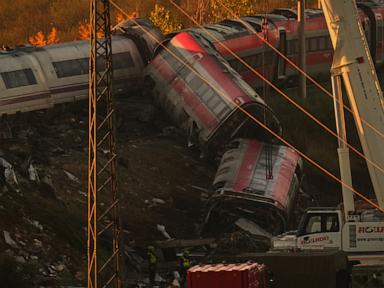
Mass casualty train collisions do not happen because transport networks suddenly forget standard safety protocols. They happen because the media, regulatory bodies, and transit executives obsess over headline body counts instead of confronting systemic failure mechanisms.
When news outlets race to report that four Americans and one Canadian were among 69 dead in a devastating Spanish rail disaster, they lock the public into a narrow, emotional loop. They convert a complex infrastructure collapse into a international census. The body count becomes the narrative. Nationalities become the hook.
It is lazy journalism, and it actively obscures why modern rail systems fail.
By focusing on the geographic origins of the victims, coverage turns a structural engineering catastrophe into a tragic twist of fate for foreign travelers. That perspective is dead wrong. High-speed rail accidents are not acts of God, nor are they random bad luck for unlucky tourists. They are mechanical, computational, and institutional failures. Until we dissect the failure of signaling logic and track monitoring with brutal clarity, we guarantee the next crash.
The Body Count Distraction
The press treats rail disasters like air crashes: count the dead, group them by nationality, interview grieving family members, and wait for a vague press conference about "investigations."
This approach hides the core problem. Modern passenger trains operate under multi-layered, redundant computer control systems—specifically ERTMS (European Rail Traffic Management System) and local automatic train protection (ATP) layers in Europe. These networks are built precisely so that human error cannot easily cause a high-energy collision.
When two trains collide or a high-speed set derailment occurs on a modern line, at least three independent safety barriers have suffered a catastrophic breakdown:
- Signal Interlocking Failure: The electronic interlocks failed to enforce absolute block occupancy rules.
- Speed Enforcement Override or Blind Spot: Automatic train protection failed to enforce emergency braking despite speed or block violations.
- Infrastructure Degradation: Physical track geometry, point switches, or rail fracture sensors were compromised without triggering an automated stop signal.
Reporting on who was sitting in coach misses the point entirely. The real question is: why did the failsafe default to motion instead of zero-speed?
In railway engineering, every safety system is designed around a single principle: fail to safety. If power cuts out, the brakes lock. If a signal loses communication, it defaults to red. If a sensor fails, the block shuts down. A collision of this magnitude means the core philosophy failed.
The Myth of Safe Modernization
Industry PR departments love to sell the public on high-speed rail as an untouchable marvel of modern tech. They point to millions of miles traveled without incident, contrasting train safety against the chaotic death toll of highway driving.
That comparison is mathematically true, but structurally deceptive.
Highways carry distributed risk. Every driver operates independently, and errors usually result in localized accidents. High-speed rail concentrates risk. Millions of passenger-miles depend on microscopic tolerances across thousands of kilometers of steel, fiber optics, and automated software logic.
When a highway system deteriorates, you get pot holes and traffic jams. When a high-speed rail line deteriorates—even by millimeters in track gauge or fractions of a second in signal latency—you get mass fatality events.
I have spent years analyzing industrial system failures. The most dangerous phase for any complex transit network is not when it is brand new, nor when it is ancient and clearly degraded. The most dangerous phase is the middle age of automation—the exact stage many European and North American rail networks inhabit right now.
During this stage:
- Legacy track legacy interfaces with modern signaling. Old physical switches are retrofitted with digital sensors, creating invisible failure points at the junction of analog iron and digital logic.
- Maintenance schedules are optimized by algorithms. Instead of physical track walks by veteran inspectors, rail operators rely on predictive maintenance models that prioritize cost efficiency over absolute physical verification.
- Operator vigilance degrades. As automation takes over daily throttle and brake management, human operators are relegated to monitoring screens. When a true system anomaly occurs, human reaction time is severely compromised by automation bias.
The public assumes modern means foolproof. In reality, modern often just means the failure points are hidden deeper inside lines of code and buried sensor relays.
Stop Asking "Who Was On Board"
If you want to understand rail safety, stop reading national identity roll calls. Start asking structural questions that force transit authorities into uncomfortable answers.
Was the Automatic Train Protection active and uncompromised?
Automatic Train Protection (ATP) is designed to take control away from an engineer if a train exceeds speed limits or passes a signal at danger. In multiple historic rail disasters, ATP systems were either turned off due to recurrent false-alarm signaling glitches or were operating in a degraded mode to avoid schedule delays.
If an ATP system was bypassed or operating under a permissive override, that is not an accident. That is a deliberate operational gamble.
Did commercial schedule pressure compromise track maintenance windows?
High-speed rail corridors operate under intense commercial demand. Heavy traffic limits maintenance windows to brief overnight slots. When track maintenance crew shifts are squeezed, subtle defects—such as micro-fractures in head-hardened rails or thermal expansion stress in continuously welded rail—are missed.
Track geometry cars can sweep a line, but they are not infallible. If track maintenance budgets or time windows are cut to preserve high-density schedules, safety margins evaporate instantly.
How are signaling anomalies handled in operational control centers?
Control room dispatchers handle thousands of data inputs every shift. When a ghost signal occupancy appears on a display panel, is the protocol to stop all traffic immediately, or is it to instruct drivers to proceed under caution at sight? The difference between those two operational choices is precisely where high-speed collisions occur.
The Hard Reality of Infrastructure Finance
Here is the truth that transit advocates and government agencies refuse to publish in press releases: absolute safety is expensive, tedious, and politically unsexy.
Governments love ribbon-cutting ceremonies for new high-speed lines. Politicians stand in front of sleek bullet trains and talk about green transit, modern infrastructure, and international connectivity.
Nobody cuts a ribbon for replacing 50,000 signaling relays deep in a rural rail corridor. Nobody holds a press conference to announce that track maintenance teams were given four extra hours of track access overnight at the expense of early morning commuter schedules.
Deferred maintenance is the invisible tax paid by transit networks worldwide. When budget constraints bite, preventive maintenance is quietly stretched from 30-day cycles to 60-day cycles. Inspection tolerances are widened by fractions of a millimeter. Staffing levels in control centers are trimmed to cut overtime expense.
Nothing breaks immediately. The system keeps running. The trains run on time. The budget metrics look fantastic on an executive dashboard.
Then, months or years later, a specific confluence of minor failures lines up perfectly. A worn switch point combines with a delayed signal relay and a minor track anomaly. A train traveling at high speed encounters a physical reality that the control software assumed was impossible.
The result is instant destruction.
Then the media steps in, lists the countries of origin of the victims, interviews local officials expressing shock, and frames the event as an unpredictable tragedy.
It was not unpredictable. It was paid for, installment by installment, through years of operational compromises and regulatory blind spots.
The Way Forward Requires Eviscerating the Narrative
We need to radically change how we react to transportation catastrophes.
Demanding foreign consulate statements and tracking passenger nationalities does nothing to secure the iron and software that millions rely on daily. It satisfies cheap curiosity while letting infrastructure operators off the hook.
If we want safer rail networks, we must demand:
- Open-source incident data logging. Every telemetry frame, ATP signal log, and control room audio recording for a major incident should be published publicly within 72 hours, not hidden behind years of closed-door commission reviews.
- Mandatory publication of deferred maintenance backlogs. Transit agencies should be legally forced to publish an itemized list of every delayed track repair, signal upgrade, and rolling stock inspection.
- Criminal liability for operational overrides. If executive leadership allows trains to run on routes with degraded safety systems to maintain schedule integrity, that decision must carry real personal legal accountability.
Anything less is theater.
The next time a high-speed train derailment or collision dominates the front pages, skip the national body counts. Ignore the vague statements of shock from corporate executives. Look directly at the signaling architecture, the track maintenance logs, and the operational override protocols.
That is where the truth lives. The rest is just noise designed to keep you from noticing that the system failed by design.