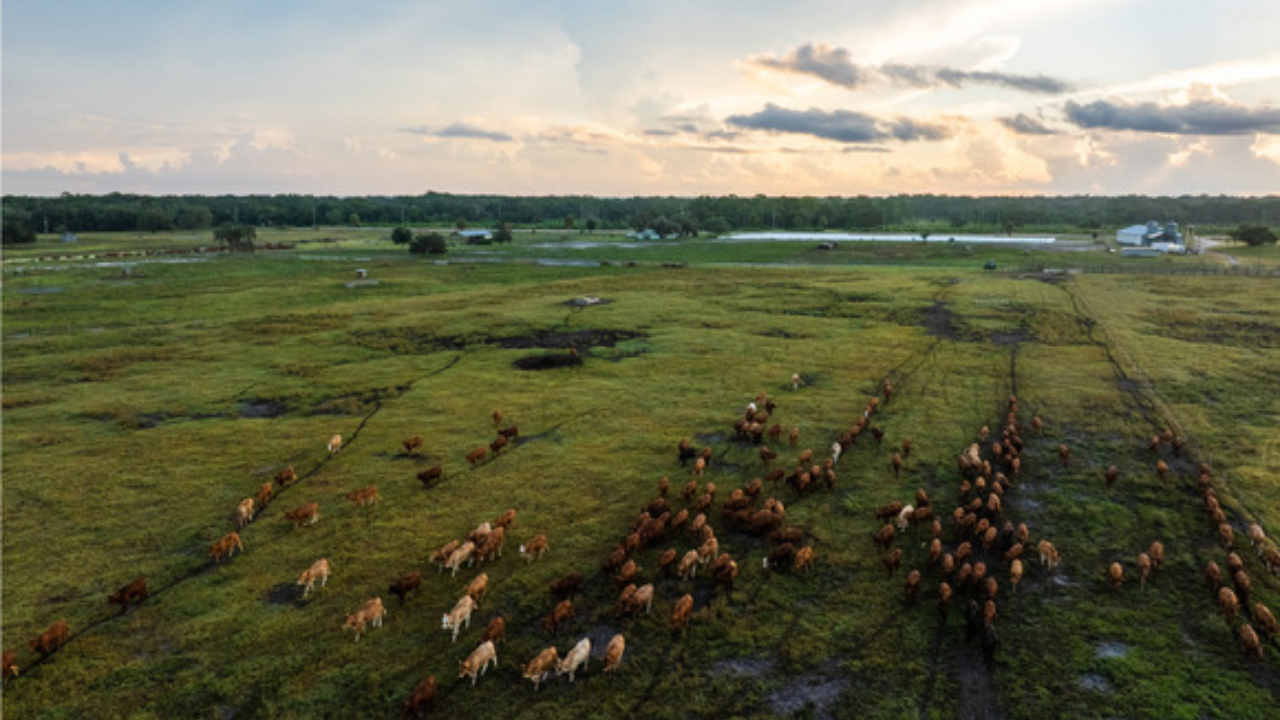
Dirt gets under your fingernails in a way that modern life tries desperately to sanitize. It smells of iron, ancient rain, and the slow decay of things that came before. If you stand still long enough on a working pasture in south-central Florida, you can hear the steady, rhythmic tearing of Bahia grass, the heavy huff of a cow shifting its weight, and the distant, low rattle of a pickup truck idling near a weathered barn.
Concrete doesn’t smell like anything. Asphalt smells like hot tar and exhaust. And asphalt is winning.
Every single week, thousands of acres of green Florida vanish beneath gray slabs of strip malls, cookie-cutter subdivisions, and four-lane highways. It happens quietly. A sign goes up on a fence line—Future Site of Something Big—and overnight, centuries of biological memory are bulldozed into gravel. You can feel the panic in the air if you spend enough time talking to multigenerational ranchers who watch the horizon fill with construction cranes. They know the math. Developers wave multi-million-dollar checks like magic wands, tempting families to cash out generations of sweat for a pile of liquid cash.
Most take the money. Who can blame them? Property taxes skyrocket. Cattle prices fluctuate wildly. Droughts and hurricanes test the soul.
Yet, sometimes, a family looks at a check with a row of zeros and says no.
That is what happened recently on four hundred ninety-eight acres of pristine, working cattle land in Florida. Instead of selling out to the relentless march of suburban sprawl, the landowners locked their gates against the future—not by abandoning the property, but by anchoring it in place through a seven-million-four-hundred-eighty-thousand-dollar conservation easement.
Let that number sink in. Millions of dollars spent not to build, but to protect. Not to pave, but to preserve.
To understand why that matters, you have to look past the bureaucratic term "conservation easement" and look at the dirt itself. A conservation easement is essentially a legal pact. The family keeps the title to their land. They keep raising cattle. They keep the morning mist rising off the ponds and the ancient oaks shading the calves. But they sign away, forever, the right to ever turn those pastures into a parking lot. They trade speculative future wealth for permanent peace.
It is a radical act in a culture addicted to perpetual growth.
Imagine the kitchen table where that decision was made. Coffee cups stained dark from decades of refills. Papers scattered across a worn wooden surface. On one side, offers from developers that could set up grandchildren for life without ever having to wake up before dawn to check a fence line during a freezing January freeze. On the other side, the ghosts of grandfathers who cleared those very palmetto flats with mules and sweat.
We talk about land use as if it were an abstract spreadsheet exercise. It isn't. It is an emotional inheritance.
When a ranch like this is shielded from development, it does more than just keep cows grazing. It protects the Florida Wildlife Corridor. Panthers, black bears, and migrating birds do not recognize property deeds; they need continuous tracts of wild and semi-wild land to survive. When a 498-acre parcel stays green, it acts as a literal sponge for stormwater, filtering millions of gallons of rainfall before it trickles down into the Floridan Aquifer—the underground limestone reservoir that gives life to the entire peninsula.
Pave that land, and the water has nowhere to go. It floods neighborhoods downstream. It picks up oil and heavy metals and flushes them straight into fragile coastal estuaries.
Keep that land green, and the earth does what it has done for millennia. It breathes.
There is an economic argument here, too, though economists often miss the poetry of it. Cattle ranches are the quiet backbone of Florida’s agricultural identity. Before tourism and tech dominated the headlines, Florida was—and in many hidden places, still is—a working frontier. Ranchers are the original land stewards. They know every sinkhole, every hammock of cabbage palms, every seasonal cypress dome. They practice controlled burns to keep the ecosystem healthy. They manage invasive species. They maintain firebreaks.
When a ranch is paved over, that institutional knowledge vanishes with the topsoil. You cannot teach a strip mall how to manage a watershed.
The nearly seven-and-a-half-million-dollar price tag for this specific easement came together through a patchwork of state and federal preservation programs, most notably Florida's Rural and Family Lands Protection Program. Critics sometimes look at figures like that and scoff, wondering why taxpayer money is being used to pay landowners not to build houses.
The answer is simple, even if it is hard for spreadsheets to capture. Try buying back an ecosystem once it's paved. Try telling an endangered panther to relocate to a retention pond behind a gas station. Try manufacturing an aquifer.
You cannot. Once the concrete cures, the story of that land is over. Its pages are sealed beneath six inches of aggregate.
This 498-acre victory won't make national nightly news. It didn't involve a high-tech breakthrough or a celebrity scandal. It happened quietly, somewhere off a two-lane Florida highway where the air smells of pine needles and wet earth. A cattle gate clicked shut. A legal document was signed in a quiet county office.
And for a little while longer, the grass kept growing. The calves kept grazing. The water kept filtering down into the dark, hidden depths of the earth, safe from the roar of the bulldozer.
It reminds us that progress does not always look like a taller building or a wider road. Sometimes, true progress is having the courage to draw a line in the dirt and say: Stop here. This belongs to the earth.