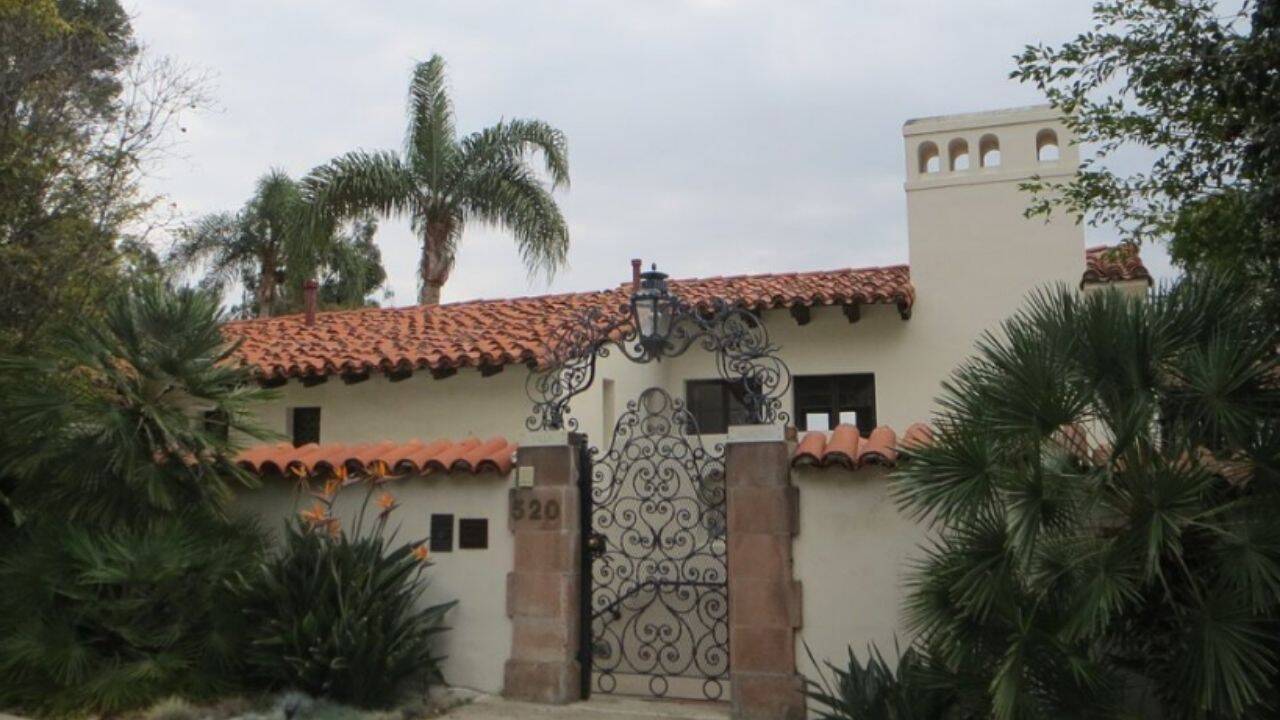
The sea air in Pacific Palisades has a way of erasing things. It carries salt that eats at iron hinges, fog that blurs the sharp edges of the coastline, and a quiet persistence that wears down human memory until yesterday feels like a rumor.
Yet, perched above the Pacific Coast Highway, a single Mediterranean villa has stubbornly refused to vanish.
Step onto its grounds today, and you are stepping into a time capsule that has somehow survived eighty-three years of history, salt, and reinvention. Villa Aurora is back. Its doors are open once more, gleaming under the California sun as if the decades between its turbulent birth and its careful rebirth never happened at all. But to look at it as merely a restored piece of real estate is to miss the entire heartbeat of the place. This was never just wood, stucco, and terracotta tiles. It was a lifeboat.
The Bargain of a Lifetime in a World on Fire
Picture the year. It is 1943.
While the rest of the world is tearing itself apart in a global conflagration, two people walk into a real estate office in Los Angeles with a sense of desperation that most of us can only imagine. They are Jewish refugees. They have escaped the tightening jaws of the European catastrophe with little more than their lives, their intellects, and a terrifying awareness of what they left behind.
Lion Feuchtwanger and his wife, Marta, did not buy a house in the Palisades to live out a glamorous Hollywood dream. They bought it because they needed silence. They needed a place where the ghosts of a burning continent could not immediately reach them.
The price tag was nine thousand dollars.
In today’s market, that figure sounds like a typographic error, a joke told by a time traveler. But in 1943, nine thousand dollars was a steep sum for exiles starting from scratch in a strange land. Lion was a celebrated novelist in Germany before the regime put a price on his head and burned his books in public squares. Marta was his anchor, his partner, and the fierce protector of his sanity.
They looked up at the hillside estate—built originally by an eccentric silent film actor who went bankrupt—and saw sanctuary. They filled the grand rooms with heavy European furniture, floor-to-ceiling bookshelves, and the heavy scent of Turkish coffee. They planted gardens. They looked out at the Pacific Ocean and tried to breathe.
When Exile Became a Salon
Houses have personalities, shaped entirely by the people who inhabit them. Villa Aurora quickly evolved from a private refuge into an intellectual epicenter for the dispossessed.
Imagine walking up that winding driveway in the mid-1940s. The fog is rolling in off the water. As you approach the heavy front door, you hear the low murmur of German, French, and accented English spilling out onto the terrace.
Inside, the living room is thick with smoke and heavy ideas. Thomas Mann is sitting in a corner armchair, nursing a drink and debating the collapse of Western civilization. Bertolt Brecht is pacing near the window, muttering lines of poetry that challenge the status quo. Arnold Schoenberg is talking about the mathematical structure of music, while Charlie Chaplin laughs at a dark joke about political madness.
This was the intellectual diaspora of Europe, transplanted overnight to the cliffs of Los Angeles.
For the people gathered in that room, Villa Aurora was the only place on earth where they could speak their minds without looking over their shoulders for the secret police. It was a salon built on survival. Lion sat at the center of it all, writing historical novels that skewered tyrants, while Marta managed the chaos, fed the starving artists, and kept the lights on through sheer force of will.
They were safe. But they never forgot the people who weren't. Every visitor who climbed that hill carried the invisible weight of friends, family, and colleagues swallowed up by the concentration camps of Europe. The laughter in the villa was always accompanied by a quiet, persistent grief.
The Long Decay and the Slow Awakening
Lion died in 1958. Marta stayed on.
For decades after her husband's passing, Marta Feuchtwanger kept the flame alive. She turned the house into a living museum, ensuring that the library remained intact and that the world did not forget the generation of thinkers who found shelter within its walls. When she passed away in 1987 at the age of ninety-six, the house stood at a crossroads.
Buildings, left to themselves, die quickly. Without human breath, roofs leak, foundations shift, and termites feast.
For a time, Villa Aurora slipped into a strange kind of limbo. It was owned by the University of Southern California, but it felt increasingly like a sleeping giant, forgotten by a city obsessed with the new and the shiny. The books were cataloged and moved. The rooms grew dusty. The Pacific salt began its slow, methodical assault on the stucco.
Yet, history has a way of refusing to stay buried.
In the late 1990s, the German government—grappling still with its historical demons and recognizing the cultural debt it owed to the exiles it had cast out—stepped in. A rescue mission began. It was not just about patching drywall or replacing roof tiles; it was an act of historical restitution.
The restoration took years. Conservators peeled back decades of paint to find the original colors. They repaired the sweeping staircases, restored the massive library shelves to their exact 1940s specifications, and secured the grounds against the perpetual threat of California mudslides and wildfires.
By the time the Palisades fire of 2018 raged through the canyons, threatening to consume everything in its path, people held their breath. The fire came dangerously close. It licked at the edges of the property. But the old villa stood its ground, protected by modern firefighting technology and perhaps a bit of ancestral luck.
What the Reopening Actually Means
Now, eighty-three years after two refugees scraped together nine thousand dollars to buy a roof over their heads, Villa Aurora has officially reopened its doors in a brand-new capacity.
It is no longer just a museum of exile or a monument to Lion and Marta. It is a working artist residency.
Today, when you walk through the arched doorways, you won't find historical reenactors in 1940s suits. You will find contemporary writers, filmmakers, composers, and scholars from Germany and around the world living and working in the exact rooms where Mann and Brecht once argued about art and politics.
Consider the poetry of that transition.
A house built by people who were driven from their homes by political extremism is now dedicated to housing artists who come seeking freedom, focus, and collaboration. In an era where borders are hardening again, where the word exile is once more dominating the nightly news, Villa Aurora stands as a physical rebuttal to the forces of exclusion.
It whispers a reminder across the decades. Ideas cannot be burned in a square. Writers cannot be silenced by exile, provided they find a table, a chair, and a piece of paper. And sometimes, the most enduring monuments we build are not towers of steel and glass in city centers, but quiet houses on coastal cliffs where weary humans can gather to rebuild the world.