The air inside the living room smelled of fresh paint and late-summer rain. It was a Tuesday evening, the kind of quiet, unremarkable night where the world outside seems to slow to a crawl. On the sofa, a family sat wrapped in the comforting routine of a shared television show. Outside, the suburbs of a quiet town slept under the amber glow of streetlights.
Then came the roar.
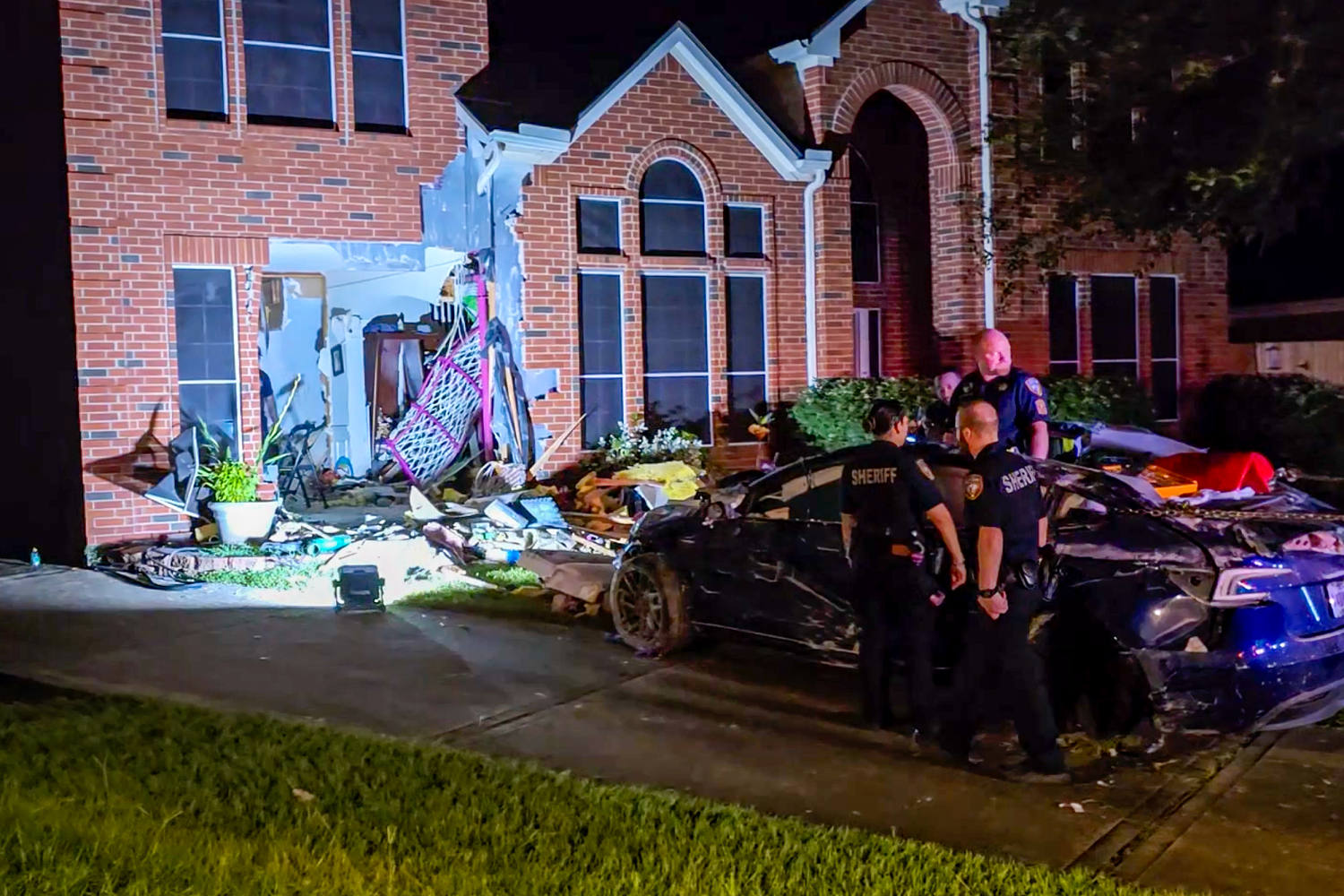
It was not the sound of thunder, nor was it the screech of locking brakes. It was a sudden, violent crescendo of tearing metal, shattering glass, and splintering drywall. In a fraction of a heartbeat, the front wall of the house vanished. A two-ton electric sedan sat resting in the ruins of what had been a quiet family sanctuary.
In the chaotic aftermath of any modern car crash, a silent, invisible battle begins. Investigators arrive not just with tape measures and cameras, but with laptops. They search for the digital pulse of the vehicle, trying to reconstruct a conversation that happened in milliseconds between a human brain and a silicon chip.
We have entered an era where we no longer just drive cars; we negotiate with them.
And as a federal investigation into this quiet suburban disaster recently revealed, that negotiation can go terribly, tragically wrong.
The Myth of the Copilot
For years, we have been sold a promise of quiet vigilance. We are told that our cars are watching when we are not. They scan the asphalt with invisible lasers, peer through the fog with radar eyes, and calculate trajectories faster than any human mind ever could. We call these systems by comforting names. They are assistants, copilots, lifeguards in the machine.
But there is a fundamental tension built into the code of every semi-autonomous vehicle on the road. It is a tension between control and submission.
Who is actually in charge?
To understand what happened on that quiet Tuesday night, we have to look at how these systems are engineered. Consider a hypothetical driver named Sarah. She is exhausted after a long day of work. The road is dark, her reflexes are dull, and she engages her vehicle's advanced driver assistance system. The car lanes itself perfectly. It maintains a safe distance from the vehicle ahead. Sarah relaxes, her hands resting lightly on the wheel, her mind drifting to tomorrow’s to-do list.
In this moment, a subtle shift occurs in Sarah's brain. Psychologists call it automation bias. It is the unconscious decision to trust the machine more than our own senses. We stop actively scanning the road. We assume the digital safety net will catch us if we trip.
But the safety net is not absolute. By law and by design, these systems are built with a critical trapdoor: the human override.
The Fatal Override
When the National Transportation Safety Board released its findings on the crash into the suburban home, the data revealed a chilling sequence of events.
The vehicle had been traveling down the road with its driver-assist features active. To the casual observer, the car was driving itself. But as the vehicle approached a curve, something went wrong. Perhaps the sensors misread the lines on the road. Perhaps the computer hesitated.
In that split second, panic took over the driver.
Instinct is a powerful, primal force. When a human being senses imminent danger, the rational brain shuts down, and muscle memory takes the wheel. The driver reached for the pedals. But instead of slamming on the brakes, the driver’s foot found the accelerator.
They pressed down. Hard.
In the design architecture of modern semi-autonomous vehicles, the driver’s input is sacred. The programmer's logic dictates that the human must always have the final say. If the car’s computer wants to stop, but the driver presses the accelerator, the computer yields. It assumes the human sees something it does not. It assumes the human has a plan.
The system disengaged. The automatic emergency braking, designed to prevent collisions, stood down. The car did exactly what it was told to do by the human foot on the pedal. It surged forward, accelerating through the curve, over the curb, and directly into the living room.
The computer did not fail. It obeyed.
The Paradox of Choice in the Silicon Age
This is the great, unspoken paradox of modern automotive technology. We buy these vehicles precisely because we want to be saved from our own human errors. We want a machine that will step in when we are distracted, tired, or overwhelmed. Yet, the moment we panic, the machine steps back and hands us the reins, even if we are about to pull ourselves over a cliff.
It is a design philosophy rooted in a deep respect for human agency, but it ignores the messy reality of human biology.
Imagine trying to catch a falling glass. Your brain does not calculate the velocity or the angle of descent; your hand simply darts out. Now imagine that instead of a glass, you are controlling a missile on wheels. When the environment changes unexpectedly, your nervous system reacts before your conscious mind can process the data. If your foot is positioned slightly to the right of where it should be, your panic response will drive that foot down into the floorboard.
The car, operating on cold logic, interprets this spasm of terror as an executive command.
Driver overrides system. Powering forward.
We are left with a system that is incredibly sophisticated under normal conditions, but incredibly fragile at the exact moment of crisis. It demands that the driver remain perfectly attentive, ready to take over a complex mechanical task in a fraction of a second, while simultaneously encouraging them to relax and let the car do the work.
It is like asking someone to sit in the passenger seat of a plane for hours, read a book, and then suddenly land the aircraft during a sudden bout of severe turbulence without warning.
Where the Responsibility Lands
When the dust settles and the sirens fade, the legal and moral weight of these incidents almost always lands on the individual behind the wheel. The official reports will list "driver error" as the primary cause. They will point to the data logs showing the accelerator pedal depressed to one hundred percent. They will note that the driver’s hands were not on the steering wheel in the seconds leading up to the impact.
Technically, legally, this is correct. The driver is the licensed operator. The manuals explicitly state that the driver must remain in control at all times.
But this explanation feels unsatisfyingly simple. It ignores the subtle ways these technologies reshape our behavior. It ignores the marketing campaigns that show drivers hands-free, smiling, looking at anything other than the road. It ignores the psychological reality of how humans interact with machines.
We cannot expect people to act like vigilant guardians of a system that is designed to make them obsolete.
But the real problem lies elsewhere, rooted in the way we talk about these advancements. We use words like "autopilot" and "self-driving" to describe systems that are, in reality, just highly advanced cruise control. We paint a picture of a future that has already arrived, when in truth, we are still living in a dangerous transition period. We are caught between the world of fully manual driving and fully autonomous transportation.
In this middle ground, the stakes are incredibly high, and the margin for error is razor-thin.
The Quiet Road Ahead
The family whose home was destroyed will eventually rebuild. The walls will go back up, the paint will dry, and the memory of that Tuesday night will fade into a dull, lingering anxiety whenever a car drives past too quickly. The driver will face the consequences of a split-second mistake, a lifetime of regret packed into the space of a single heartbeat.
And the rest of us will continue to drive, navigating this uneasy alliance between human instinct and digital logic.
We must begin to look at our relationship with our cars with a renewed sense of skepticism. We must acknowledge that the safety net is not a physical barrier, but a digital suggestion—one that can be instantly dissolved by a nervous twitch or a panicked stomp of a foot.
As you drive home tonight, watch the blue lights glowing on the dashboard of the cars around you. Look at the drivers staring straight ahead, trusting the silent algorithms to keep them in their lanes. The technology is beautiful, remarkable, and incredibly capable.
But it is not a savior.
The ultimate responsibility still rests in the palms of your hands and the sole of your shoe. And the machine, for all its brilliant complexity, will gladly let you drive right through the wall if you tell it to.