A quiet Saturday afternoon on the via Emilia in central Modena transformed into horror. A grey Citroën C3 barreled down the street at nearly 100 kilometers per hour, hitting a cyclist before veering directly onto the sidewalk. The impact tossed pedestrians into the air. The car didn't stop. It accelerated, targeting more people before crashing violently into a shop window, trapping a woman underneath.
Eight people lay injured, four critically. What followed was a chaotic chase, an attempted murder with a knife, and immediate political weaponization. Italian Prime Minister Giorgia Meloni rearranged her international schedule to fly directly into the aftermath.
But as the dust settles in the northern Italian city, the initial rush to blame geopolitical or religious terrorism has collided with a much messier, institutional reality.
The Terror That Wasn't
When the news first broke on May 16, 2026, the internet did what it always does. It jumped to conclusions. Given Europe's history with vehicle-ramming attacks, the immediate assumption leaned toward a coordinated strike on innocent civilians. Foreign officials were quick to issue statements condemning it as a "terror attack." Inside Italy, right-wing League Party leader Matteo Salvini immediately seized on the suspect's background, blasting him as a "second-generation criminal" on social media.
The facts paint a different, far more tragic picture.
The driver was identified as Salim El Koudri, a 31-year-old Italian citizen born in Bergamo and raised right there in Modena. He wasn't an operative hiding in the shadows. He was an economics graduate with absolutely no criminal record. He was also unemployed and dealing with severe schizoid mental disorders since 2022.
By Sunday morning, Interior Minister Matteo Piantedosi explicitly ruled out any political or religious motives. This wasn't an act of ideological warfare. It was a catastrophic breakdown of mental health. The Prefect of Modena, Fabrizia Triolo, even confirmed that El Koudri wasn't under the influence of drugs or alcohol at the time. He was simply in the middle of a massive psychiatric crisis.
Acknowledging this doesn't minimize the horror of what happened. It shifts the problem from national security to a failure in community care.
Civilian Bravery on Corso Adriano
We need to talk about what happened immediately after the car smashed into that storefront. The crash itself was gruesome. Two female tourists—a 69-year-old from Poland and a 53-year-old from Germany—suffered catastrophic leg injuries. One lost both her legs at the scene, while the other required amputations at the hospital.
Instead of waiting for the police, everyday people stepped up.
When El Koudri kicked open his car door and ran down Corso Adriano, a group of bystanders chased him. A local man named Luca Signorelli managed to grab him. El Koudri pulled out a knife and tried to stab Signorelli in the head and chest. For 11 agonizing seconds, Signorelli fought him off, pinning the attacker's wrist to prevent a fatal blow.
He wasn't alone for long. A group of local residents, specifically identified by witnesses as citizens of Egyptian and Pakistani origin, jumped into the scuffle. They threw themselves onto the armed driver, disarmed him, and held him down until the police arrived to make the arrest.
It's a stark contrast to the anti-immigrant rhetoric that filled social media feeds within minutes of the crash. The very people helping to save lives on the street belonged to the demographic groups being demonized online. Modena Mayor Massimo Mezzetti praised their immense bravery, noting that they showed incredible civic sense under life-threatening conditions.
Why Meloni Changed Her Plans
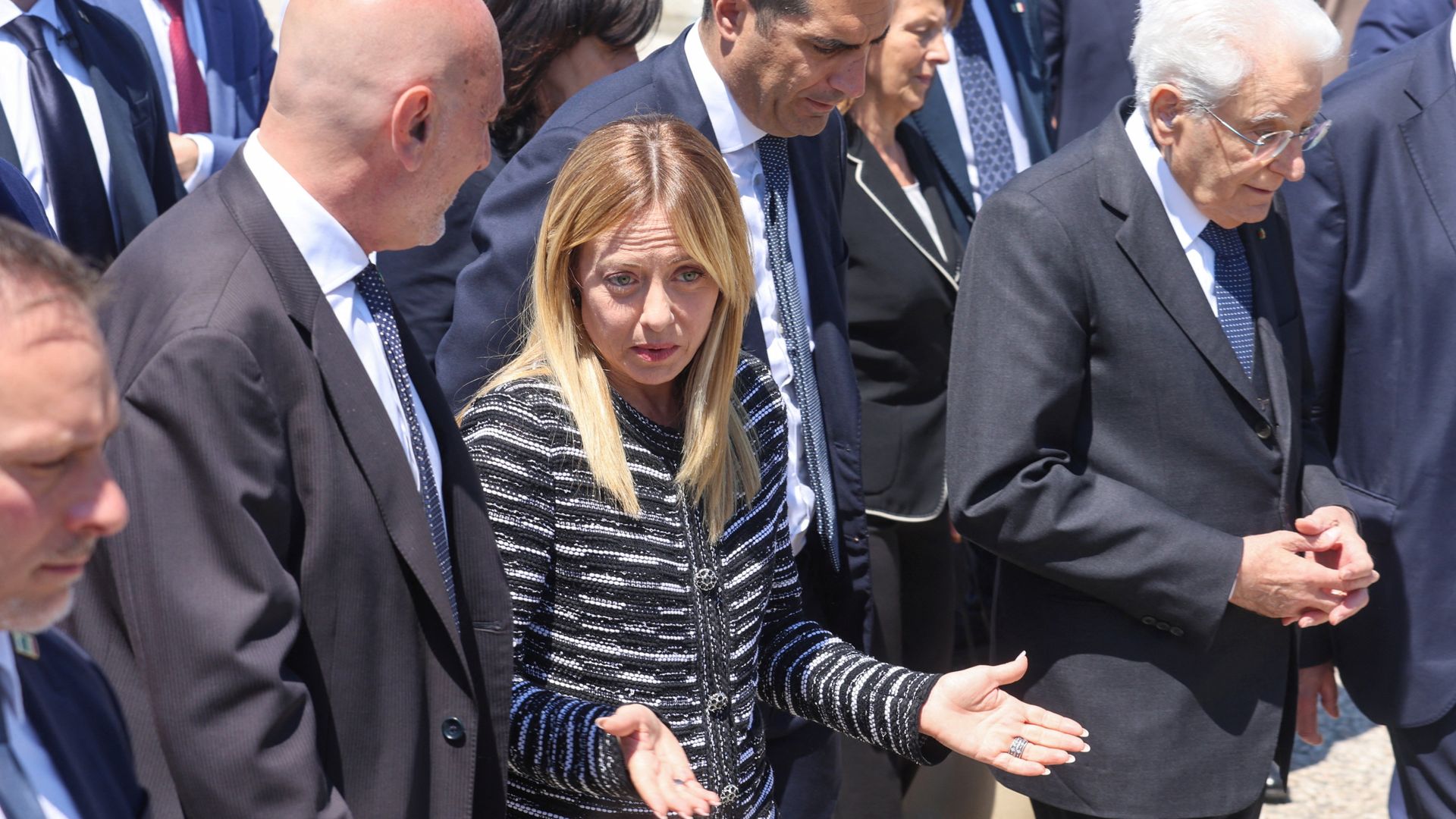
The political response was swift. Prime Minister Giorgia Meloni was attending the Europe Gulf Forum in Navarino, Greece, when the attack happened. She cancelled her upcoming trip to Cyprus and flew back to Italy, heading straight to the region alongside President Sergio Mattarella.
On Sunday, Meloni and Mattarella visited the wounded at Baggiovara Hospital in Modena and Maggiore Hospital in Bologna.
Meloni's presence in Modena wasn't just about offering solidarity to the victims, though that was the public face of the visit. It was a calculated move to manage a highly volatile narrative. Her government relies heavily on a firm, law-and-order platform. By arriving on the ground immediately, she kept control of the situation before local anger could be co-opted by more radical factions within her own coalition.
She expressed deep concern and demanded full accountability, but notably aligned with her Interior Minister's assessment that the incident was psychiatric, not terrorist. It's a rare moment of political restraint in an environment that usually rewards immediate escalation.
What Needs to Happen Now
If you are tracking how European cities handle public safety and mental healthcare, the Modena incident offers a blueprint of what's broken. We don't need more political finger-pointing; we need structural changes in how known psychiatric patients are monitored.
Here is what local authorities and healthcare systems must address immediately:
- Audit Psychiatric Tracking: El Koudri had been receiving treatment for serious schizoid disorders for four years. The community needs to know how an individual with a documented history of severe mental health crises was able to operate a vehicle at high speeds in a crowded city center without intervention.
- Support the First Responders and Bystanders: The civilians who intervened, including Luca Signorelli, require immediate psychological and financial support. Standing up to an armed attacker leaves deep scars.
- Address Public Infrastructure: The via Emilia is a central artery. Cities must reconsider physical barriers—like bollards—in high-pedestrian zones to prevent vehicles from easily mounting sidewalks, regardless of the driver's motive.
The tragedy in Modena shows that a car can be just as lethal as a bomb, even when there's no political manifesto behind the wheel. Treating this strictly as a criminal or immigration issue misses the point entirely. It ignores the quiet, systemic failures happening in mental health units long before a driver ever starts an engine.