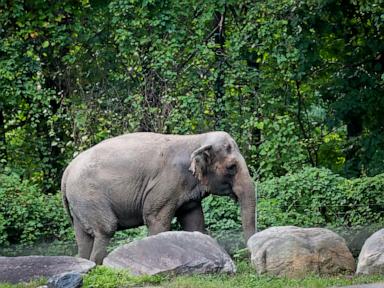
The media coverage surrounding the euthanasia of Happy, the celebrated Asian elephant at the Bronx Zoo, followed a predictable, tear-jerking script. Journalists dusted off the old obituaries. They lamented the passing of a sentient icon. They regurgitated the same comfortable narrative we have heard for two decades: Happy was a self-aware genius trapped in a concrete valley, proving her near-human intelligence by touching an 'X' on her forehead in front of a mirror.
It is a beautiful story. It is also a profound misinterpretation of cognitive science.
The lazy consensus loves a martyr. For years, animal rights activists and well-meaning commentators used Happy as a battering ram to fight for legal personhood. They claimed her success in the 2005 Mirror Self-Recognition (MSR) test proved she possessed an internal world akin to our own. When the Bronx Zoo rightfully and humanely ended her suffering at age 54 due to irreversible, age-related decline, the internet erupted with grief masked as moral superiority.
They missed the entire point of the research. Worse, they anthropomorphized an apex herbivore to satisfy a human savior complex. We need to stop looking at animal cognition through the warped lens of our own reflection.
The Mirror Test is a Flawed Human Metric
Let us start with the science that everyone loves to quote but few bother to analyze. In 2005, researchers Diana Reiss and Frans de Waal placed a massive mirror in Happy’s enclosure. They painted a white mark on her head. Happy marked the spot. Boom: academic history.
Except the Mirror Self-Recognition test, pioneered by Gordon Gallup in 1970, is not the definitive yardstick for consciousness. It is a visual test designed by primates, for primates. Primates are intensely visual creatures. We navigate, judge, and socialize primarily through sight.
Elephants do not.
An elephant’s world is a rich tapestry of olfaction and infrasonic vibration. They perceive reality through scent and seismic waves traveling through their feet. To demand that an elephant prove its intelligence by understanding light bouncing off a silvered glass pane is like testing a human's intelligence by asking them to track a bloodhound's scent trail through a marsh. It is a rigged game.
When Happy passed the test, she did not prove elephants are 'just like us.' She proved that one specific elephant, under highly artificial conditions, could map her proprioception to a visual anomaly. Dozens of other elephants have failed or ignored the mirror test entirely. Does that mean they are mindless husks? Of course not. It means they realized a reflection has no smell, no sound, and therefore, no relevance to their existence.
I have spent years analyzing how public policy and corporate strategy bend to bad data. This is a classic case of selection bias. We take a single anomaly, turn it into a benchmark, and build an entire emotional empire on a statistical outlier.
The Legal Personhood Illusion
The fixation on Happy’s mirror performance fueled a long, expensive legal campaign by the Nonhuman Rights Project. They filed writs of habeas corpus, arguing Happy was being unlawfully imprisoned. They wanted her moved to a sanctuary. The case went all the way to the New York State Court of Appeals, which ultimately ruled 5-2 that Happy was not a legal person.
The activists screamed betrayal. In reality, the court saved us from a legal disaster.
Granting legal personhood to an animal based on cognitive milestones like the MSR test creates a dangerous, slippery slope. If Happy deserves habeas corpus because she recognizes herself in a mirror, what do we do with magpies? Eurasian magpies passed the mirror test too. Should we appoint legal counsel for birds nesting in suburban gutters? Cleaner wrasse—a tiny species of fish—have passed the mirror test by scraping parasites off their bodies after looking at a reflection. Do we extend constitutional rights to reef fish?
Conversely, what happens to animals that fail the test? Dogs fail the mirror test consistently. They look behind the glass or ignore it because a reflection lacks an olfactory signature. Yet, any dog owner knows their pet possesses a complex emotional life, memory, and problem-solving capabilities. By tying legal rights and moral worth to a visual cognitive trick, activists accidentally created a hierarchy that devalues animals with different sensory priorities.
Imagine a scenario where we rewrite the legal code to reflect this anthropocentric bias. We would end up protecting creatures that mimic human traits while abandoning species with alien, yet equally complex, evolutionary adaptations. It is a terrible way to manage conservation.
The Sanctimonious War on Zoos
The narrative surrounding Happy’s death inevitably devolved into an attack on the Bronx Zoo. Critics painted her life as a tragedy of solitary confinement, demanding she spend her final years at a massive sanctuary in Tennessee or California.
This demands a reality check.
Moving a geriatric, 54-year-old elephant with chronic joint issues across state lines is not an act of mercy. It is a potential death sentence. Transporting a multi-ton mammal requires immense physical stress, sedation, and a complete disruption of her familiar environment. The staff at the Bronx Zoo—veterinarians and keepers who monitored her every step for decades—knew that the trauma of relocation far outweighed the optics of a 'free' sanctuary.
Sanctuaries are not magical utopias where animals revert to wild states. They are fenced, managed facilities facing the exact same geriatric care challenges as accredited zoos. The Bronx Zoo chose stability and meticulous medical management over public relations. They managed her arthritis, monitored her diet, and when her quality of life collapsed, they made the agonizing, correct choice to euthanize.
To call her life a failure because she lived in New York instead of an open plain is to misunderstand the reality of modern conservation. The wild is shrinking. Poaching, habitat fragmentation, and climate extremes mean that managed populations in accredited institutions are a vital genetic hedge against extinction.
The Cost of Our Sentimentality
Our obsession with Happy’s 'humanity' distracts from the brutal realities of wildlife preservation. We want to care about the elephant that acts like us. We write think pieces about the elephant that looks in the mirror.
But conservation cannot survive on sentimentality.
While lawyers spent hundreds of thousands of dollars arguing over whether Happy could be defined as a person in a New York courtroom, wild Asian elephant populations quietly cratered. They are losing their migratory corridors to human development in India and Southeast Asia. They are being poisoned by farmers protecting crops. They are dying from lack of space, not lack of mirrors.
The money and media oxygen consumed by the Happy trial could have funded anti-poaching patrols, purchased land corridors, or engineered community fences abroad. Instead, it was spent trying to validate a human philosophical debate using a captive animal as a prop.
Here is the uncomfortable truth: Happy did not care about the mirror. She did not care about the Nonhuman Rights Project. She cared about her keepers, her routines, and her daily comfort. She lived a long life, far outlasting the average lifespan of her wild counterparts, who frequently die young from disease, starvation, or human conflict.
Stop Looking in the Mirror
The collective mourning for Happy is not really about the elephant. It is about us. It is human narcissism disguised as empathy. We look at an elephant, see it touch a mark on its head, and celebrate because we think we found a kindred spirit in the animal kingdom. We value her because she reflected our image back at us.
We need to abandon this narrow, narcissistic framework. An animal does not need to recognize its reflection to deserve our protection. It does not need to pass a primate-biased intelligence test to have value.
Happy’s legacy is not that she proved elephants are self-aware in the human sense. Her legacy is that she exposed the limitations of human understanding. She showed that we are still desperate to colonize the minds of other species, bending their behavior to fit our legal codes and emotional needs.
The Bronx Zoo did right by Happy at the end. They ignored the shouting from the gallery, looked at the clinical reality, and provided a dignity that nature rarely grants. It is time for the rest of the world to drop the mirror, stop looking for ourselves in the eyes of giants, and accept them for what they actually are: magnificent, alien, and entirely independent of our definitions.