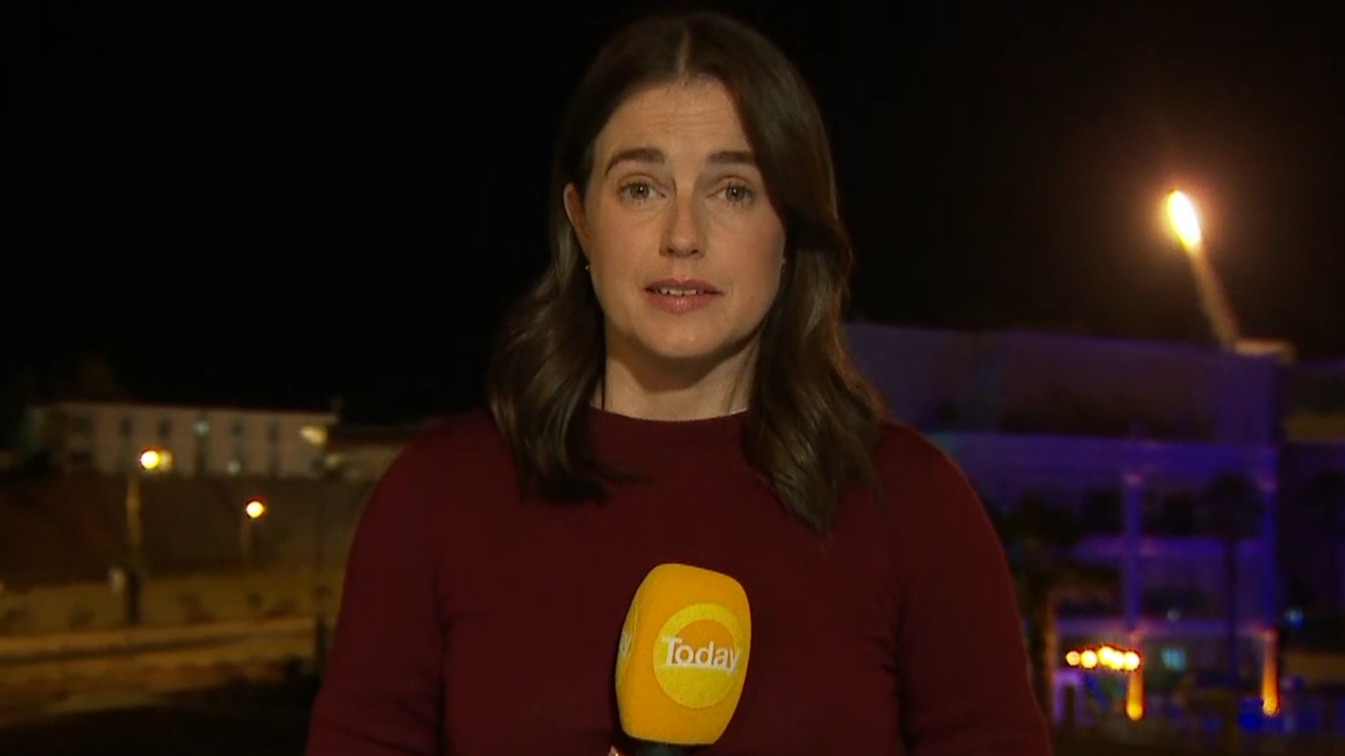
The sight of a missile ignition streaking across a darkened sky behind a reporter is no longer a freak occurrence of timing. It is the new baseline. When Allyson Horn, a correspondent for Australia’s Today show, was caught on camera as a projectile launched from a nearby battery in Israel, the footage didn't just capture a moment of danger; it captured the systematic collapse of the "buffer zone" between the press and the kinetic reality of modern conflict.
This isn't a story about a lucky escape. It is a story about the changing mechanics of how we consume war and the shrinking physical distance between those who tell the story and the weapons used to write it. The footage shows Horn preparing for a live hit, the mundane rituals of a broadcast—adjusting earpieces, checking lighting—interrupted by the violent, sudden roar of an interceptor. The immediate reaction of the crew was to seek cover, a standard operational procedure that has become as common as a sound check.
The Illusion of the Safe Distance
For decades, the standard for frontline reporting involved a calculated distance. Correspondents stood on "press hills" or stayed in "Green Zones," using long lenses to compress the space between the camera and the combat. That distance has evaporated. In the current Middle Eastern conflict, the geography of the battlefield is so compact and the weaponry so ubiquitous that there is no longer a "backstage" for the media.
When a missile fires directly behind a journalist, it exposes the logistical gamble every major network takes. They are positioning crews in high-density areas where military hardware is embedded within or adjacent to civilian and media hubs. This isn't just about the bravery of the individual; it’s about a structural shift where the proximity to the "boom" has become a metric for authenticity in a hyper-competitive attention economy.
The Architecture of Interception
To understand why these clips are becoming more frequent, we have to look at the physics of modern air defense. Systems like the Iron Dome or its newer counterparts are not static monuments. They are mobile, distributed, and designed to react in seconds.
How the Proximity Gap Closed
- Launch Detection Speed: Radar systems now identify threats and trigger counter-measures so quickly that reporters often hear the outgoing interceptor before they hear the incoming siren.
- Urban Integration: In a small geographic footprint, launch batteries are frequently placed near hotels or government buildings where the press is stationed.
- The 360-Degree Front: Unlike traditional trench warfare with a clear "forward line," modern missile exchanges happen overhead. The "front" is vertically above the reporter.
The technical reality is that an interceptor missile, such as the Tamir, travels at supersonic speeds. If a battery is located within a kilometer of a media hotel, the sound and visual flash reach the reporter in less than three seconds. There is no time for a producer to yell "clear the set." The event happens simultaneously with the broadcast.
The Psychological Toll of the Loop
There is a secondary, quieter crisis unfolding in the newsrooms that manage this footage. When a video of a reporter nearly being hit by a missile goes viral, it creates a feedback loop. Digital editors see the engagement metrics spike. These clips are shared more than the actual investigative reports the journalists were sent there to produce.
This creates a perverse incentive. If the "near miss" is what drives the numbers, the pressure to stand in increasingly precarious positions grows. We are witnessing the gamification of war reporting, where the threat to the journalist becomes the primary narrative, overshadowing the human cost of the conflict they are meant to be covering.
The industry calls this "the money shot," but the currency is the lives of the crew. Journalists like Horn are seasoned professionals, but they are working within a system that now expects the spectacle of fire in the background. If the sky is quiet, the shot is considered "dead air."
The Technological Failure of the "Safe Set"
We were promised that technology would make reporting safer. Drones, remote-operated cameras, and AI-enhanced zoom were supposed to take the human out of the line of fire. The opposite has happened.
The demand for "live and local" has forced crews back into the streets. Satellite latency has decreased, meaning audiences expect a real-time response to events. If a missile fires, the audience expects the reporter to react to it while the camera is rolling. This creates a high-stakes performance where the journalist must balance their professional composure with the very real instinct to survive.
The Cost of the Gear
Consider the weight of the equipment. A modern reporter in a conflict zone is often wearing:
- Level IV Body Armor: Weighing between 15 and 25 pounds.
- Ballistic Helmet: Adding another 3 pounds of neck strain.
- Comms Gear: Encumbering their ability to hear ambient threats.
When that missile fired behind Horn, she had to move while carrying this weight. The "mobility gap" is the difference between life and death. If a reporter is too weighed down by the gear required to stay safe, they cannot move fast enough to actually reach safety.
The Ethics of the Viral Near-Miss
Every time a network posts a clip of their reporter flinching as a missile launches, they are monetizing a life-threatening moment. It is a delicate ethical tightrope. On one hand, it shows the reality of the situation on the ground. On the other, it turns the journalist into a protagonist in a thriller rather than an observer of a tragedy.
We have to ask: Does this footage help the public understand the geopolitical nuances of the missile exchange, or does it simply provide a fleeting adrenaline rush? The "behind the scenes" look at the danger often lacks the context of where that missile is going, who it is targeting, or the civilians who don't have a camera crew and a flak jacket.
The Vanishing Boundary
The missile launch captured behind the Australia Today crew is a symptom of a world where there is no longer any "away." The battlefield has expanded to include the very spots where we stand to watch it.
As precision weaponry and air defense systems become more advanced, they also become more invisible until the moment of ignition. The flash of light behind a reporter is the sound of a boundary disappearing. It is the moment where the observer is forcibly integrated into the event.
The industry needs to stop treating these moments as "viral highlights" and start recognizing them as a warning. We are pushing the limits of proximity. Eventually, the gap between the reporter and the launch will close entirely.
The reality of 21st-century conflict is that the camera is never truly out of the line of fire, because the line of fire is everywhere. We are no longer watching the war from the sidelines; we are standing in the middle of the battery, hoping the outgoing fire doesn't draw an incoming response before the segment ends.
News organizations must re-evaluate the "live hit" at all costs. If the only way to prove you are "on the ground" is to stand in front of an active missile battery, the industry has lost its sense of proportion. The story is what the missile does when it lands, not the fact that it made a reporter jump.
The next time you see a streak of light behind a journalist, look past the flash. Look at the logistics that put them there. Look at the equipment that failed to protect them from the shockwave. Look at the screen and realize that the distance between your living room and the launchpad is getting shorter every day.
We are all closer to the fire than we think.
Verify the ballistic reports. Check the battery locations. Demand that newsrooms prioritize the safety of the crew over the "intensity" of the shot before the next viral clip doesn't end with a reporter moving to safety, but with a camera feed cutting to black.