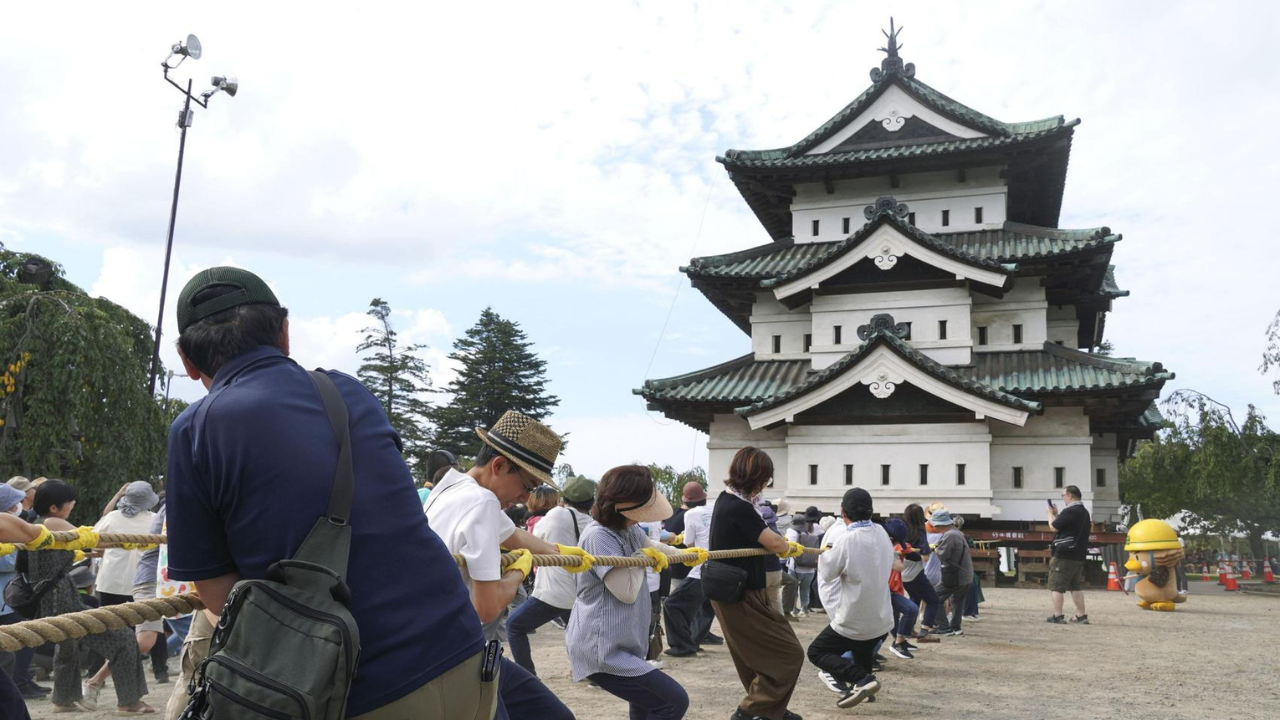
In the spring of 2020, a small army of citizens gathered in the shadow of Marugame Castle to physically haul a 400-ton stone wall back to its original position using traditional ropes and sheer human muscle. This monumental community effort captured global headlines, framed largely as a charming, whimsical throwback to feudal efficiency.
Beneath the viral videos of chanting locals and synchronized pulls lies a grueling engineering reality. Moving ancient masonry weighing hundreds of tons is not a cultural festival trick. It is a masterclass in structural preservation, forced by strict conservation laws and the unyielding physics of historic stone.
The Engineering Crisis Beneath the Stone Walls
Marugame Castle sits proudly in Kagawa Prefecture, boasting one of the few remaining original wooden keeps in Japan. Its stone base, known as ishigaki, survived earthquakes, typhoons, and centuries of weathering. Then came the relentless rainstorms of 2018.
Water pressure behind the ancient ramparts reached a critical threshold. Millions of gallons of trapped moisture exerted hydrostatic force against the interior fill of the wall. The stones began to bulge, shift, and eventually collapse, sending tons of granite tumbling down the hillside.
Traditional restoration methods hit an immediate roadblock. Modern heavy machinery, specifically pneumatic cranes and tracked excavators, would crush the surrounding earth, destabilize adjacent centuries-old foundations, and fracture the hand-carved surfaces of the original stones. Conservation authorities faced a stark choice. Bring in mechanized monsters that risked destroying the historic integrity of the site, or find a way to manipulate massive weights with surgical precision.
Civil engineers looked backward to go forward. They realized that the original builders who stacked these stones in the early seventeenth century possessed an intuitive understanding of load distribution that modern brute-force techniques frequently ignore.
Anatomy of an Ancient Defensive Wall
To understand why a thousand people were needed to move a collapsed section, one must examine how ishigaki is constructed. These are not modern concrete barriers bound by mortar. They are dry-stacked puzzles of interlocking granite blocks.
Each stone was chiseled by hand to fit snugly against its neighbor. The outer face is only the visible skin of a much deeper, highly sophisticated structural system. Behind the facade lies a graded rubble core designed to drain water rapidly during heavy downpours.
When a section collapses, every single stone becomes a unique archaeological artifact. Workers cannot simply dump them back into a pile. They must catalog, map, and reposition every block in its exact historical sequence.
- The Face Stones: The exterior granite blocks, weighing anywhere from a few hundred pounds to several tons each.
- The Backfill: Graduated stone rubble that prevents soil liquefaction and manages seismic shockwaves.
- The Foundation Tier: The anchor stones resting directly on bedrock, carrying the entire vertical load of the rampart.
When the 2018 slide occurred, thousands of individual pieces tumbled out of alignment. Restoring them required repositioning the largest composite sections without altering their micro-topography. Every scratch and wedge mark tells a story of seventeenth-century quarry work.
The Logistics of Human Power
Mobilizing a thousand citizens to pull a 400-ton aggregate structure sounds inefficient in an era of hydraulic jacks and computer-guided pulleys. Yet, human labor offers a distinct mechanical advantage in delicate preservation sites.
Engineers constructed a timber sled system mimicking Edo-period transport methods. The massive stone components were lashed securely to heavy wooden beams using traditional hemp and synthetic rope configurations designed to distribute tension evenly across the rough surfaces.
Human power provides immediate tactile feedback. When an operator pulls a mechanical lever, they rely on hydraulic gauges. When a thousand people pull together on thick ropes, the collective organism feels the friction points. If a stone catches on an uneven root or a stray pebble, the tension drops instantly, halting the movement before a corner chips off.
This synchronization is exhausting. It requires rigorous choreography. Elders who remember traditional community work methods stood shoulder-to-shoulder with university students and local civil servants. They moved in cadence, responding to rhythmic shouts that synchronized their exertion down to the fraction of a second.
Physics dictates that overcoming static friction requires a massive initial spike in force, followed by a steadier maintenance load. Once the wooden sled broke inertia on its greased timber tracks, the combined weight became manageable for the human chain.
Why Modern Heavy Machinery Failed the Test
We assume technology always provides the superior path. In heritage conservation, technology often acts as a clumsy bull in a fragile china shop.
Consider the access constraints at Marugame Castle. The pathways winding up the mountain are narrow, steep, and flanked by ancient cherry trees and secondary defensive gates. Bringing in a fifty-ton mobile crane would require tearing down historic stone gates, paving over sensitive archaeological strata, and compacting the soil to a degree that would kill the root systems of trees older than the modern nation-state.
Furthermore, standard steel cables and modern clamping claws leave permanent gouges on soft granite. Historic stones are living records of ancient tool marks, quarry patterns, and weathering. Damaging the physical fabric of the stone during the repair process defeats the purpose of preservation.
The human-powered sled distributed the downward pressure over a much wider surface area than steel tracks. By utilizing wooden rollers and controlled incline planes, the restoration team bypassed the need for heavy engines entirely.
The Broader Implications for Global Heritage
The success of the Marugame recovery operation challenges how modern urban planners think about disaster recovery in historic districts. Around the world, rising sea levels and erratic weather patterns threaten heritage sites from Rome to Kyoto.
When monuments crumble, the automatic reflex is to call a commercial contractor with the biggest machinery available. The Japanese experiment demonstrates that low-impact, high-participation conservation can achieve structural integrity while fostering a deep sense of civic stewardship.
People who spend a day pulling ropes to save a castle wall view that landmark differently for the rest of their lives. It stops being a passive tourist backdrop and transforms into a shared community responsibility. The stones are heavy, but the cultural weight of maintaining them belongs to everyone.
The wall at Marugame now stands restored, its granite faces locked back into their seventeenth-century geometry. The scars of the 2018 collapse remain visible upon close inspection, a deliberate choice by conservators who view damage as part of the structure's continuous biography.
The ropes have been coiled and stored. The crowds have dispersed back into the modern hum of the city below. Yet the granite blocks remain, balanced on the hillside, held in place by an invisible web of physics, history, and communal muscle that no machine could ever replicate.