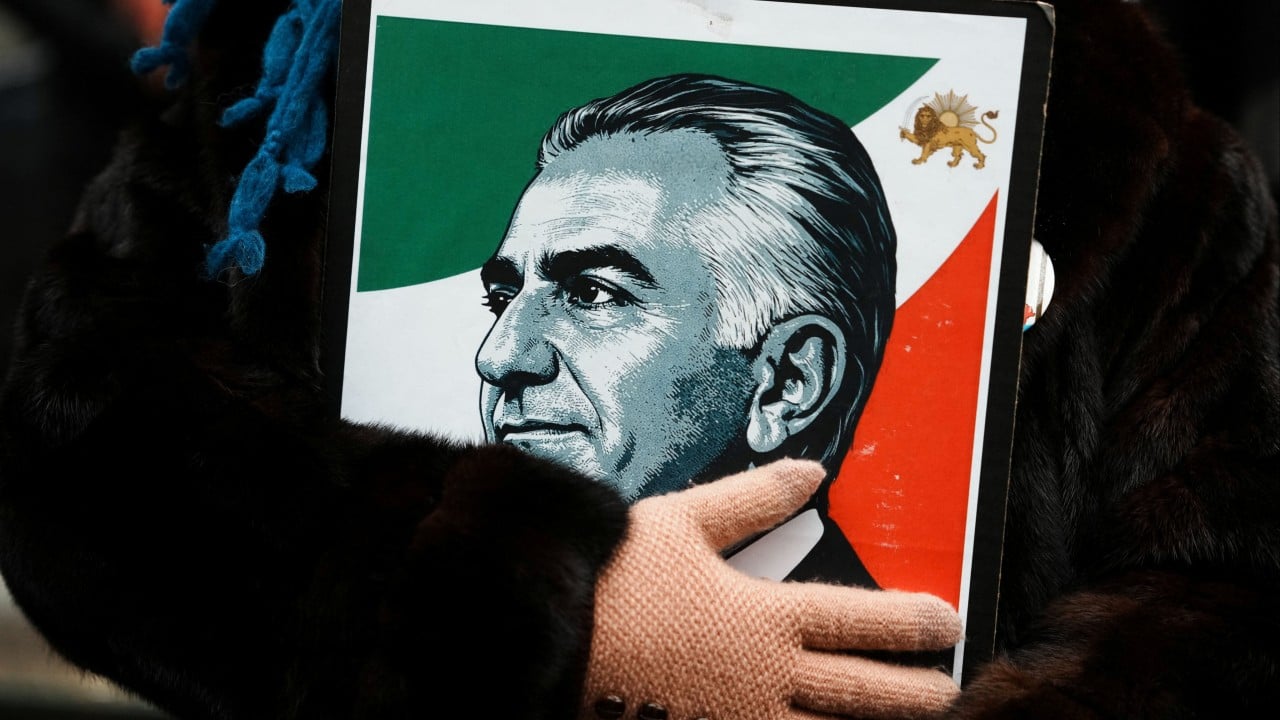
The chattering classes in D.C. and the diaspora are currently obsessed with a fairytale. It goes something like this: Reza Pahlavi, the exiled heir to a throne that vanished in 1979, will waltz into a post-Islamic Republic vacuum and magically decouple Iran from the Chinese Communist Party. They call it a "gambit." I call it a fundamental misunderstanding of how the world actually works.
If you think a change in leadership in Tehran—even one as drastic as a restoration or a secular democracy—will suddenly turn Iran into a Western satellite that shuns Chinese capital, you haven't been paying attention to the last twenty years of Eurasian integration. The belief that Pahlavi can "flip the script" on Beijing isn't just optimistic; it’s commercially illiterate.
The Infrastructure Trap Is Already Sprung
The mainstream argument suggests that Iran’s current reliance on China is a marriage of convenience born of desperation and sanctions. The logic follows that once sanctions vanish, Iran will pivot to Europe and the United States.
Wrong.
China hasn't just been buying discounted oil; they have been hard-wiring themselves into the Iranian geography. We are talking about the 25-Year Strategic Accord. This isn't a mere trade deal. It is a fundamental rewiring of Iranian telecommunications, rail, and port authority.
When a nation installs Huawei as its backbone and builds its high-speed rail on Chinese gauges, you don't just "unplug" that because a new guy is sitting in the office. I’ve seen emerging markets try to swap vendors mid-stream. It results in a decade of systemic paralysis. If Pahlavi tries to rip out the Chinese digital and physical architecture, he isn't "freeing" Iran; he’s ensuring the lights go out for a generation.
The Myth of the Western Savior
Let’s talk about the "People Also Ask" obsession: Will Western companies flood back into Iran if the monarchy returns?
The assumption is a resounding yes. The reality is a cold, hard no.
Boardrooms in Paris, Munich, and New York are risk-averse to the point of cowardice. They remember the JCPOA whiplash. They remember billions in stranded assets. Even with a "friendly" government, Western compliance departments will treat Iran like a leper colony for at least a decade.
China, conversely, does not have a compliance department that cares about "political volatility" in the same way. Beijing views a decade of chaos as a buying opportunity. While a Pahlavi-led government would be begging Shell and Total to return, Sinopec will already be there, on the ground, with cash in hand and no questions asked about human rights or democratic norms.
Pahlavi’s "gambit" ignores the fact that the West has lost its appetite for nation-building and high-risk capital expenditure. China is the only player left with the stomach for the Iranian "landscape"—to use a word I hate—of risk.
The Oil Reality Check
The naive consensus is that Iran can leverage its oil to regain independence.
Let’s look at the math. Iran’s current production capacity is crippled. To modernize its fields, it needs approximately $160 billion to $200 billion in immediate investment.
$$Total Investment \approx \sum_{i=1}^{n} (CapEx_{field_i} + OpEx_{tech_i})$$
Where $n$ represents the dozens of aging super-giant fields currently operating at 40% efficiency.
Who provides that $200 billion?
- The World Bank? Too slow.
- The US Congress? Good luck getting that appropriation through a divided house.
- Private Equity? Not at those risk premiums.
The only entity with that kind of liquidity and a strategic need for the crude is Beijing. By the time Pahlavi finishes his first press conference at the UN, the Chinese state banks will have already drafted the loan agreements that exchange that $200 billion for thirty years of guaranteed supply at a 15% discount.
That isn't flipping the script. That’s signing the second page of it.
The Diaspora's Blind Spot
The exile community loves to talk about "sovereignty." They forget that sovereignty is a luxury for the solvent.
Iran is currently a bankrupt state with a collapsing currency and a disappearing water table. The environmental catastrophe alone—the drying of Lake Urmia and the exhaustion of aquifers—requires technological intervention that the West usually ties to "green" strings and ESG (Environmental, Social, and Governance) requirements.
China doesn't care about your ESG score. They will sell you the desalination plants and the coal power to run them, and they will take payment in mineral rights.
Pahlavi is selling a vision of a Swiss-style neutrality or a pro-Western tilt. But you cannot be neutral when you owe your neighbor the equivalent of your entire GDP. The "nuance" the competitor article missed is that Iran’s debt to China isn't just financial; it’s existential.
The Regional Power Play
The "Peacock Throne’s Gambit" assumes that Iran’s neighbors—specifically the Saudis and Emiratis—want a strong, Western-aligned, democratic Iran.
Think again.
Riyadh and Abu Dhabi have spent the last three years hedging. They joined BRICS. They are pricing oil in Yuan. They have realized that the US security umbrella is full of holes. If Iran suddenly turns into a Western-backed powerhouse under Pahlavi, it creates a massive competitive threat to the GCC’s dominance in the energy markets.
The GCC would prefer a neutered Iran that stays in the Chinese orbit because it keeps the power balance predictable. If Pahlavi thinks he can pivot to the West without facing a silent blockade from his own "allies" in the region, he’s dreaming.
The Hard Truth About Pahlavi’s Leverage
What is Pahlavi actually offering Beijing?
The competitor piece suggests he can offer "stability" in exchange for "better terms." This is a fundamental misunderstanding of the Chinese negotiation playbook. Beijing doesn't want better terms; they want all the terms.
They have spent forty years watching the US flip-flop between presidents every four to eight years. They don't trust Western-aligned leaders because those leaders can be voted out or overthrown. They trust leaders who are so indebted to the Chinese banking system that they cannot leave.
Imagine a scenario where Pahlavi takes power. Within six months, he faces a massive strike from the labor unions and the "bazaaris." He needs $50 billion to stabilize the Rial and pay the civil service.
- Washington offers $2 billion in "humanitarian aid" tied to 50 conditions.
- Beijing offers $50 billion in "infrastructure credits" with a single signature.
Which one does he take? If he wants to keep his head, he takes the Chinese money. And just like that, the "gambit" ends.
Stop Asking the Wrong Question
The media keeps asking: "How will Iran change its foreign policy under Pahlavi?"
The real question is: "Does Iran even have the agency to change its foreign policy?"
The answer is no. Geography is destiny, but debt is a prison. Iran is a land bridge for the Belt and Road Initiative. It is the terminal point for the International North-South Transport Corridor (INSTC). It is the energy battery for the world’s second-largest economy.
A change in the figurehead at the top doesn't change the physics of the bank account.
The Actionable Reality
If you are an investor or a policy-maker, stop betting on a "Great Pivot." Instead, start looking at how a post-clerical Iran would actually function as a more efficient, secular vassal state of the Chinese trade bloc.
The most "contrarian" move Pahlavi could make isn't trying to fight Beijing—it's trying to out-negotiate them from a position of total weakness. And history shows that's a losing hand.
Stop looking for a hero to save the West's interests in the Middle East. The West checked out of that theater years ago. Pahlavi isn't flipping the script; he’s just hoping for a better font.
Don't buy the hype of a democratic dawn that brings a Western sunrise. The sun in Tehran is rising in the East, and it’s painted red.