The stability of the Taiwan Strait is currently governed by a precarious equilibrium between Beijing’s "Red Line" calculus and Washington’s strategic ambiguity. While headlines focus on the rhetoric of conflict, the underlying reality is a rigid structural collision between China’s internal legitimacy requirements and the United States’ regional security architecture. Xi Jinping’s warnings to the Trump administration are not merely diplomatic posturing; they represent a formal communication of the Cost-Benefit Threshold for kinetic intervention. To understand the risk of conflict, one must analyze the three distinct pillars of Chinese strategic intent: Sovereignty Inflexibility, Integrated Deterrence, and the Economic Interdependence Variable.
The Sovereignty Inflexibility Framework
For the Chinese Communist Party (CCP), the "One China" principle functions as a foundational legal and political axiom. This is not a negotiable policy preference but a core interest that sits at the top of their hierarchy of survival. Any perceived deviation from this status quo by the United States—such as high-level diplomatic recognition or a significant shift in arms sales—triggers an automatic response mechanism. If you liked this article, you should read: this related article.
The logic follows a binary path:
- Legitimacy Maintenance: The CCP’s domestic mandate is tied to the restoration of national territorial integrity. Relinquishing the claim to Taiwan would represent a catastrophic loss of internal authority.
- The Precedent Risk: Beijing views Taiwanese independence as a potential catalyst for fragmentation in other sensitive regions. Consequently, the cost of a military conflict, however high, is mathematically weighed against the perceived cost of state disintegration.
The specific warning issued to the Trump administration targets the transactional nature of the president's previous foreign policy. Beijing’s primary fear is that Taiwan will be used as a "bargaining chip" in trade negotiations. By framing Taiwan as a non-negotiable conflict trigger, Xi seeks to remove the island from the economic chessboard and place it back into the realm of existential security. For another look on this event, check out the recent coverage from Associated Press.
The Cost Function of Kinetic Intervention
Military conflict in the Taiwan Strait is often analyzed through the lens of capability, but the more accurate metric is the Incentive Gap. China’s strategy relies on "Anti-Access/Area Denial" (A2/AD) systems designed to raise the price of American intervention to a level that exceeds the United States' national interest.
Defensive Asymmetry
The People’s Liberation Army (PLA) has spent three decades optimizing for a specific theater. Their advantage lies in geographic proximity, allowing for high-density missile saturation and land-based air support. The United States, conversely, faces the "Tyranny of Distance," requiring a massive logistical tail to maintain presence. The structural bottleneck for the U.S. is not the number of ships, but the speed of replenishment and the vulnerability of forward-deployed bases like Guam and Kadena.
The Threshold of Success
For Beijing, a military operation does not require a total defeat of the U.S. Navy. It only requires the creation of a "fait accompli"—a rapid change in the ground reality that makes a counter-intervention by the U.S. politically and economically unfeasible. Xi’s rhetoric serves to signal that the PLA is reaching a level of technical maturity where the window for such an operation is no longer theoretical but operational.
The Economic Interdependence Variable
The primary deterrent against immediate conflict is not just military force, but the Mutual Assured Destruction of Supply Chains. This creates a paradox where the economic health of both nations is tethered to the very geography they are contesting.
- Semiconductor Dominance: Taiwan produces over 90% of the world’s most advanced logic chips. A kinetic conflict would effectively halt global production for high-end computing, AI, and consumer electronics.
- Maritime Choke Points: The Taiwan Strait is a primary artery for global trade. A blockade or active combat zone would redirect or freeze trillions of dollars in cargo, leading to an immediate global recession.
- Fiscal Contagion: The interconnectedness of Chinese and American financial markets means that a hot war would lead to the immediate freezing of assets, a collapse of the dollar-yuan exchange stability, and a breakdown of the global credit system.
Beijing’s strategy involves decreasing its reliance on Western technology—specifically through the "Made in China 2025" and "Dual Circulation" initiatives—to lower the cost of the Economic Interdependence Variable. Until China achieves a higher degree of technological self-sufficiency, the economic cost of an invasion remains a significant constraint on Xi’s military options.
Deciphering the Trump-Xi Communication Channel
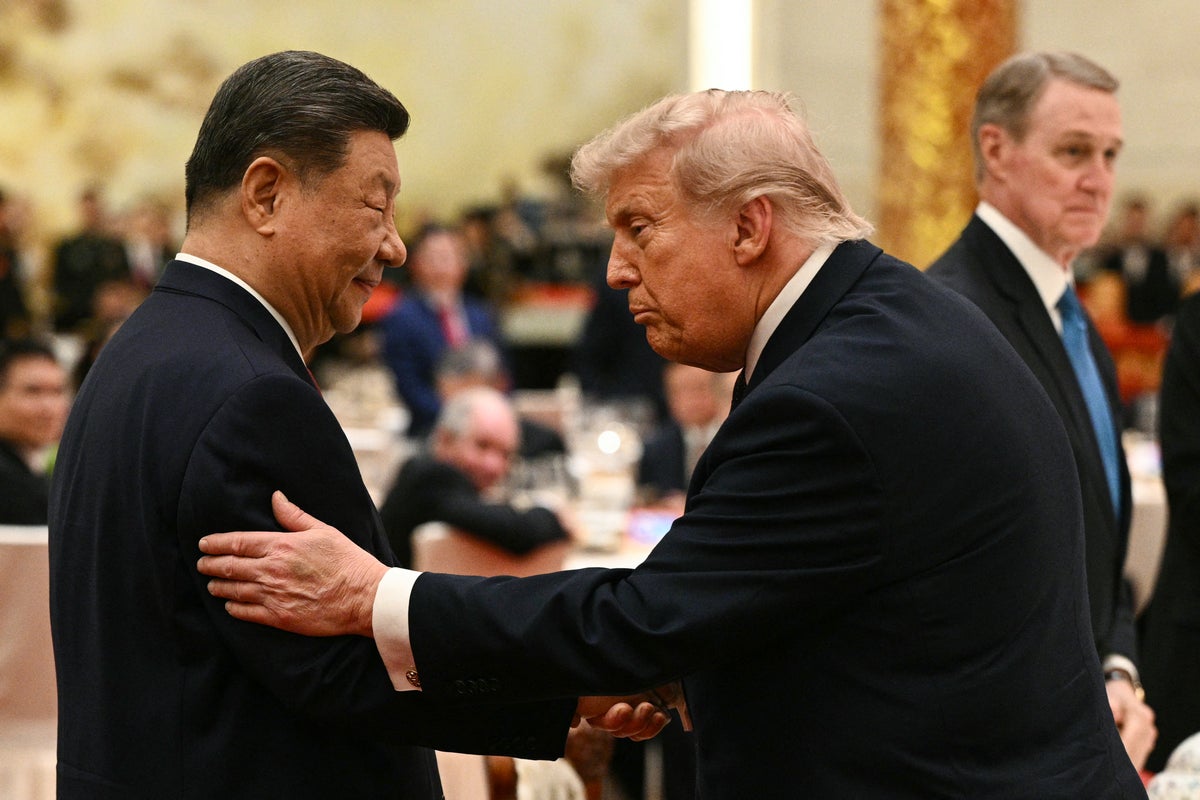
The re-entry of Donald Trump into the executive branch introduces a high degree of Strategic Volatility. The previous administration’s approach was characterized by a departure from traditional State Department protocols in favor of direct, personality-driven negotiations. Beijing views this unpredictability with a mixture of opportunism and dread.
The specific "warning" regarding Taiwan serves two tactical purposes:
- Establishing a Baseline: It defines the boundaries of the relationship before formal negotiations begin. It is an attempt to freeze the U.S. posture on Taiwan to focus the upcoming bilateral friction on trade and tariffs.
- Testing Resolve: By escalating rhetoric early, Beijing gauges the new administration's appetite for risk. If the U.S. response is muted, it signals a potential softening of the security umbrella. If the response is aggressive, it confirms the need for further military buildup.
This communication is hampered by a fundamental cognitive dissonance. Washington views its support for Taiwan as a defense of the "rules-based international order." Beijing views the same support as an illegal interference in domestic affairs and a violation of the 1972, 1979, and 1982 Joint Communiqués. This lack of a shared vocabulary ensures that any "warning" is interpreted through a lens of maximum suspicion.
The Bottleneck of Strategic Ambiguity
For decades, the policy of Strategic Ambiguity—where the U.S. refuses to say whether it would definitely defend Taiwan—served to deter both sides. It deterred Taipei from declaring independence (fearing a lack of U.S. support) and deterred Beijing from invading (fearing U.S. intervention).
However, this framework is currently failing due to two structural shifts:
- The Erosion of Parity: As the PLA’s local superiority grows, the "ambiguity" of U.S. intervention becomes less of a deterrent. If Beijing believes they can win before the U.S. can respond, the threat of intervention loses its weight.
- Political Polarization in Washington: Support for Taiwan has become one of the few bipartisan consensus points in the U.S. Congress. This has led to a series of legislative moves—such as the Taiwan Policy Act—that effectively strip away the "ambiguity" in favor of "strategic clarity."
When the U.S. moves toward clarity, it forces Beijing to accelerate its own timeline. If China believes that Taiwan is permanently drifting toward an independent status backed by a formal U.S. alliance, the "wait and see" approach becomes a liability. This creates a feedback loop where defensive actions by one side are viewed as offensive provocations by the other.
Structural Constraints on De-escalation
A peaceful resolution faces a significant "Commitment Problem." Even if the Trump administration offered a grand bargain—concessions on Taiwan for trade benefits—neither side could trust the other to uphold the agreement long-term.
The limitations of the current diplomatic path are rooted in:
- Irreversible Military Posturing: Once A2/AD systems are deployed and carrier strike groups are positioned, the "friction" of de-escalation is immense. Moving forces back is viewed as a sign of weakness.
- Domestic Nationalism: In both the U.S. and China, domestic political incentives reward "hawkish" behavior. There is no political "profit" in advocating for a compromise on Taiwan in either the halls of the CCP or the U.S. Congress.
- The Silicon Shield Decay: As the U.S. pushes for "onshoring" semiconductor manufacturing via the CHIPS Act, the economic cost of a Taiwan conflict (to the U.S.) may eventually decrease. Ironically, making the U.S. more resilient to the loss of Taiwan’s chips may make a military defense of the island less certain in the long run.
The risk is not necessarily a planned invasion, but a Tactical Miscalculation. An accidental collision in the air or sea, followed by a breakdown in high-level military-to-military communication, could trigger a ladder of escalation that neither leader intended to climb.
The strategic play for the upcoming administration is not found in more rhetoric, but in the hardening of regional alliances (AUKUS, Quad) while simultaneously establishing a reliable "crisis hotline" that bypasses public-facing diplomacy. The objective is to maintain the cost of conflict at a level that remains prohibitively high for Beijing, while avoiding the specific "Red Line" triggers that force Xi’s hand for the sake of domestic survival. The "Taiwan Problem" cannot be solved; it can only be managed through the continuous calibration of deterrents and the avoidance of symbolic provocations that offer no tangible security gain.