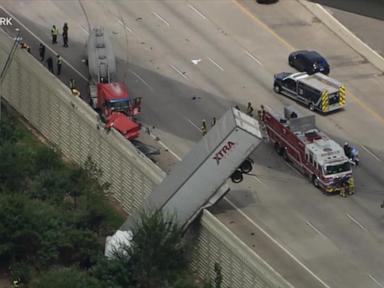
Commercial vehicle jackknife and suspension events on primary freight corridors trigger immediate compounding systemic losses across regional supply chains. When a heavy combination vehicle breaches the physical boundaries of a elevated highway or overpass structure—hanging precariously over an edge—the immediate response protocol shifts from standard vehicle towing to a critical structural stabilization problem. The resulting multi-hour roadway closure is rarely caused by towing logistics alone; it is forced by structural physics, hazardous materials assessments, and high-capacity rigging requirements.
The Kinematics of Structural Vehicle Suspension
A suspended semi-trailer creates a high-risk dynamic force profile on localized infrastructure. Unlike a standard rollover resting fully on a roadbed, a dangling combination vehicle creates three distinct points of failure that emergency management teams must mitigate simultaneously. Don't forget to check out our earlier article on this related article.
- Center of Mass Displacement: The vehicle's center of gravity shifts outside the footprint of the drive axles. The structural integrity of the kingpin assembly and fifth wheel coupling becomes the sole barrier preventing total structural detachment.
- Localized Structural Load: The weight distribution concentrates entirely along a single section of bridge barrier or guardrail designed to absorb impact energy, not to sustain continuous static shear forces ranging from 15 to 40 tons.
- Fuel and Fluid Containment Breach: Standard saddle tanks on Class 8 trucks carry up to 300 gallons of diesel fuel. Suspended angles induce extreme hydrostatic pressures on fuel lines and tank caps, creating an imminent hazardous material spill hazard directly onto lower-level roadways or sensitive ecosystems.
Standard heavy-duty wreckers cannot clear a suspended rig using straightforward winch operations. Applying force without counter-balancing the suspended mass alters the center of gravity, risking an uncontrolled descent to the surface below.
Operational Timelines and the Four Phase Recovery Framework
The multi-hour delays reported during elevated highway closures stem from strict operational sequencing. Expediting any single phase increases the probability of catastrophic failure. If you want more about the context of this, The Guardian offers an excellent breakdown.
Phase 1: Dynamic Load Stabilization
The initial ninety minutes are dedicated strictly to anchoring the vehicle. Responders deploy heavy rotator cranes equipped with high-tonnage winches to establish primary tension points. This counteracts the moment of torque exerted by the hanging payload. Tactical teams anchor the cab or trailer to stationary structural elements of the highway infrastructure using specialized synthetic web slings or grade 100 transport chains.
Phase 2: Hazardous Material Mitigation and Weight Reduction
Prior to attempting vertical recovery, recovery specialists must systematically reduce the total suspended mass. Transferring fuel out of compromised tanks prevents structural ignition and reduces vector weight. If the cargo within the trailer has shifted, offloading freight manually or mechanically becomes necessary to prevent internal dynamic load shifts during the lift phase.
Phase 3: Synchronized Dual-Rotator Rigging
Lifting a Class 8 vehicle back onto a structural deck requires synchronized dual-rotator operations. A single crane point creates a pivot point around which the load can rotate uncontrollably. Two minimum 50-ton rotator cranes must position themselves at opposing angles to execute a controlled arc lift, balancing both the horizontal vector and vertical lift force.
Phase 4: Infrastructure Integrity Inspection
Following the physical removal of the wreckage, state department of transportation engineers must conduct a structural inspection of the roadway and barrier wall. A structural guardrail or concrete jersey barrier that has sustained high static loading often suffers sub-surface fracturing, rendering the lane unsafe for public travel until temporary barriers are placed.
Supply Chain Degradation and Economic Spillover Metrics
The economic impact of a major corridor shutdown extends far beyond the immediate localized traffic delay. Freight transit routes operate under tight scheduled arrival windows. A three-hour complete stoppage on a high-density interstate creates operational ripple effects that linger for days.
| Delay Metric | Operational Consequence | Financial Impact Vector |
|---|---|---|
| Primary Corridor Stoppage | Complete traffic standstill across all lanes | Direct driver fuel burn and lost hours of service (HOS) |
| Secondary Route Saturation | Local arterial roads overwhelmed by detoured traffic | Accelerated municipal road wear and localized transit delays |
| Downstream Logistics Misses | Freight misses distribution center drop windows | Contractual financial penalties and supply chain inventory gaps |
Commercial drivers operate under strict federal Hours of Service regulations. A driver stuck in a four-hour closure burns through non-driving duty hours. Once a driver reaches their daily duty limit, the vehicle must legally come to a complete stop at the earliest available location, compounding parking shortages along primary freight corridors and stalling inventory delivery timelines downstream.
Vulnerabilities in Regional Incident Management Frameworks
The primary bottleneck in managing complex heavy vehicle incidents lies in the delay between initial dispatch and the arrival of specialized equipment. Standard towing contracts awarded by municipal or state agencies often prioritize general towing capabilities over specialized heavy rigging expertise.
Municipal emergency response units frequently lack real-time structural load modeling capabilities at the command post level. Determining whether a bridge railing can sustain a secondary pull force requires rapid engineering assessments that are rarely integrated into standard incident command structures. This lack of immediate technical data forces operational leads to adopt conservative delay-heavy recovery strategies to prevent secondary structural collapse.
Optimizing recovery timelines requires pre-contracting specialized heavy-recovery operators with mandated response windows, alongside deploying automated incident routing algorithms that divert heavy commercial traffic miles before they enter the bottleneck funnel created by an elevated corridor closure.
To minimize systemic economic losses from heavy vehicle suspensions, highway transportation authorities must transition from reactive towing protocols to predictive corridor management. Contracting specialized heavy-lift operators directly into regional emergency operations centers ensures immediate deployment of dual-rotator equipment. Simultaneously, deploying dynamic overhead message sign arrays up to forty miles upstream allows long-haul commercial drivers to execute tactical re-routes before crossing structural chokepoints, preserving regulatory hours of service and preventing secondary arterial gridlock.