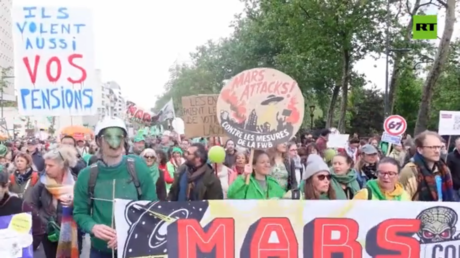
Brussels is usually a city of quiet bureaucracy and gray suits. That changed today. The streets of the EU capital are currently a sea of flags, whistles, and shouting protestors. It’s loud. It’s angry. And it’s a clear sign that the patience of the European working class has finally snapped.
You’ve probably heard the term "austerity" tossed around by economists and news anchors. It sounds clinical. It sounds like a necessary diet for a country’s budget. But for the thousands of trade union members and workers marching past the European Commission headquarters, austerity isn't a theory. It's a pay cut. It's a crumbling school. It's the inability to heat a home while corporate profits hit record highs.
They aren't just complaining about high prices. They’re protesting against a specific set of fiscal rules that the European Union is trying to bring back into force. These rules would force member states to slash public spending to meet strict debt and deficit targets. The marchers today have a simple message: we can't afford your math anymore.
The Return of the Debt Rules
For a few years, the EU's strict fiscal rules were on ice. When the pandemic hit, the "Stability and Growth Pact" was suspended. Governments were allowed to spend what they needed to keep their economies alive. It was a rare moment of common sense in a system usually obsessed with 3% deficit limits.
Now, the "frugal" nations are pushing to turn the taps off. The proposed reforms would require countries with high debt-to-GDP ratios—think Italy, Greece, France, and Belgium—to make massive annual cuts. We’re talking billions of euros.
Trade unions, specifically the European Trade Union Confederation (ETUC), argue that these rules are a "straitjacket." They aren't wrong. If you force a country to cut spending during an inflation crisis, you aren't fixing the economy. You're starving it. You’re making it impossible to invest in the very things that actually drive growth, like green energy and better infrastructure.
Why This March Is Different
I’ve seen plenty of protests in Brussels. Most are small, niche, and easily ignored by the MEPs sipping coffee in the Parliament building. This one feels different because the coalition is so broad. You have transport workers, healthcare staff, teachers, and factory workers all standing together.
They’re pointing out a glaring hypocrisy. While the EU tells citizens to tighten their belts, it’s also asking for massive increases in defense spending and industrial subsidies. The money is there. It’s just not being spent on the people who actually make the continent run.
"We are being told there is no money for schools, but there is always money for bank bailouts or military expansion," one protestor told me. It's a sentiment that's echoing across the continent. This isn't just a Belgian issue. It’s a European crisis of legitimacy.
The Human Cost of Fiscal Discipline
Let’s get specific. What does austerity actually look like in 2026?
It looks like the 10% cut to public services that some economists are predicting if these rules pass. It means longer wait times at hospitals that are already understaffed. It means freezing the wages of public sector workers while the cost of groceries continues to climb.
The ETUC has released data showing that real wages in the EU have fallen by several percentage points when adjusted for inflation. Meanwhile, corporate margins in sectors like energy and food have stayed incredibly healthy. The wealth hasn't trickled down. It’s stuck at the top, and the new EU rules would only cement that reality.
The Green Transition Trap
Here is the part nobody talks about. The EU wants to be the global leader in the "Green Deal." They want to reach net-zero emissions. That’s a noble goal, but it’s also an incredibly expensive one.
If you bring back austerity, you kill the Green Deal. It's that simple.
Public investment is the only way to build the charging networks, high-speed rail, and renewable grids we need. Private capital won't do it alone because the returns aren't fast enough. By forcing member states to cut their budgets, the EU is effectively sabotaging its own environmental targets. It's a policy contradiction that borderlines on the absurd.
What the Critics Get Wrong
You'll hear some pundits say that these protestors are "irresponsible." They’ll argue that debt is out of control and that we need "fiscal responsibility" to protect future generations.
That’s a tired argument.
True responsibility means ensuring that the next generation has a functioning society to inherit. High debt is a problem, sure. but a society with no healthcare, failing schools, and a broken climate is a much bigger one. The "frugals" in the EU leadership are treating the economy like a household budget. It isn't. A government's spending is someone else's income. When you cut that spending, you shrink the entire economy, making the debt even harder to pay back. It’s a death spiral we’ve seen before, most notably in Greece a decade ago. We should have learned our lesson then.
The Political Stakes
The timing of this march isn't an accident. We are heading into a major election cycle. If the mainstream EU parties continue to push for belt-tightening while people struggle to buy bread, they are handing a gift to the far-right.
Populist movements across Europe thrive on this exact frustration. They point to the "Brussels elite" and say, "See? They don't care about you." And when the Brussels elite is busy debating 0.5% deficit reductions while the streets are full of angry workers, it’s a hard point to argue against.
Taking Action Beyond the Streets
If you're watching these videos and wondering what happens next, don't expect a sudden U-turn from the European Commission. They move slowly. But the pressure is mounting.
The next few months will be critical as the final details of the fiscal rules are negotiated. If you want to see a different outcome, it’s time to look beyond the headlines.
- Support local trade union chapters that are coordinating with the ETUC. They are the ones actually sitting at the negotiating tables.
- Contact your representatives in the European Parliament. They need to know that "fiscal discipline" is a losing platform.
- Demand transparency on how much your specific country will be forced to cut under the new proposals. Knowledge is the best weapon against bad policy.
The people in the streets of Brussels today aren't just "protestors." They are the canary in the coal mine. If the EU ignores them, the social contract that holds the union together might just start to unravel for good. Stop looking at the spreadsheets and start looking at the people. They’ve had enough.