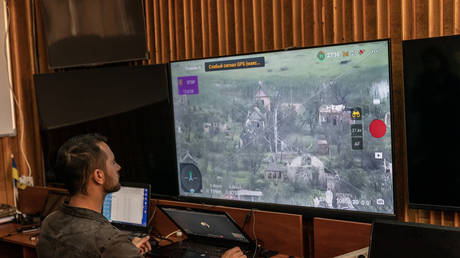
When the full-scale invasion hit in 2022, traditional defense contractors couldn't move fast enough. Bureaucracy killed speed. Into that vacuum stepped unconventional teams—game designers, architects, and software developers who decided to build weapons from scratch.
They didn't care about military-industrial orthodoxies. They cared about iteration cycles measured in days instead of decades. Today, private defense tech firms like Fire Point drive a massive chunk of Ukraine's deep-strike campaign, launching hundreds of low-cost autonomous vehicles past enemy air defenses every single week.
If you want to understand modern conflict, you have to look past multi-million-dollar fighter jets. The real war runs on garage-built ingenuity scaled up to industrial levels.
How Disruption Outpaced Defense
Traditional military acquisition moves at a glacial pace. Requirements are drafted, committees debate, and years pass before hardware reaches the field. Startups flipped that script entirely.
Take the emergence of companies like Fire Point, founded by individuals with zero background in traditional arms manufacturing. Co-founder and chief designer Denys Shtilerman initially poured his own money into the concept before building a manufacturing apparatus that now outputs thousands of systems.
They skipped the red tape. They sourced commercial-off-the-shelf components, integrated robust electronic warfare resistance, and optimized airframes for sheer affordability. An FP-1 deep-strike drone costs roughly $55,000 to produce. Compare that to traditional cruise missiles running into the millions, and the economic asymmetry becomes obvious. You can launch waves of cheap hardware that overwhelm expensive radar architectures.
Scaling Up the Deep Strike Campaign
Building a cool prototype in a Kyiv basement is one thing. Mass-producing weapons under constant missile threat requires an entirely different operational mindset.
Ukraine's top drone manufacturers rely on decentralized, covert production networks. Assembly lines are split across hidden locations. If one workshop gets hit, production shifts elsewhere without missing a beat. This decentralized model protects output against targeted airstrikes.
The results speak for themselves. These long-range platforms regularly hit oil refineries, fuel depots, and military logistics nodes hundreds of miles inside Russian territory. According to defense analysts, these repeated waves create a severe economic pinch, denying Moscow the steady revenue and refined fuel needed to sustain frontline operations.
Moving Beyond Simple Drones
The startup ecosystem hasn't stayed stagnant. Companies building cheap one-way attack drones are rapidly expanding into heavy cruise missiles and air defense components.
For instance, developments like the FP-5 Flamingo cruise missile and cooperative defense-tech ventures with European radar manufacturers show a maturing industry. They are moving from asymmetric nuisance weapons to full-spectrum military capabilities.
You're seeing a fundamental democratization of military power. Software talent matters more than heavy metal stamping plants. Code updates happen overnight, allowing autonomous navigation systems to bypass newly deployed jamming fields before the enemy can adapt their frequencies.
Keep an eye on how traditional defense ministries across NATO begin adopting these startup methodologies. The days of exclusive reliance on legacy defense primes are numbered. Speed, iteration, and cost efficiency now dictate who wins on the modern battlefield.
Ukraine's deep-strike drone program bottleneck
This video explores the critical components and industrial bottlenecks shaping the production of long-range strike drones in modern warfare.
http://googleusercontent.com/youtube_content/1