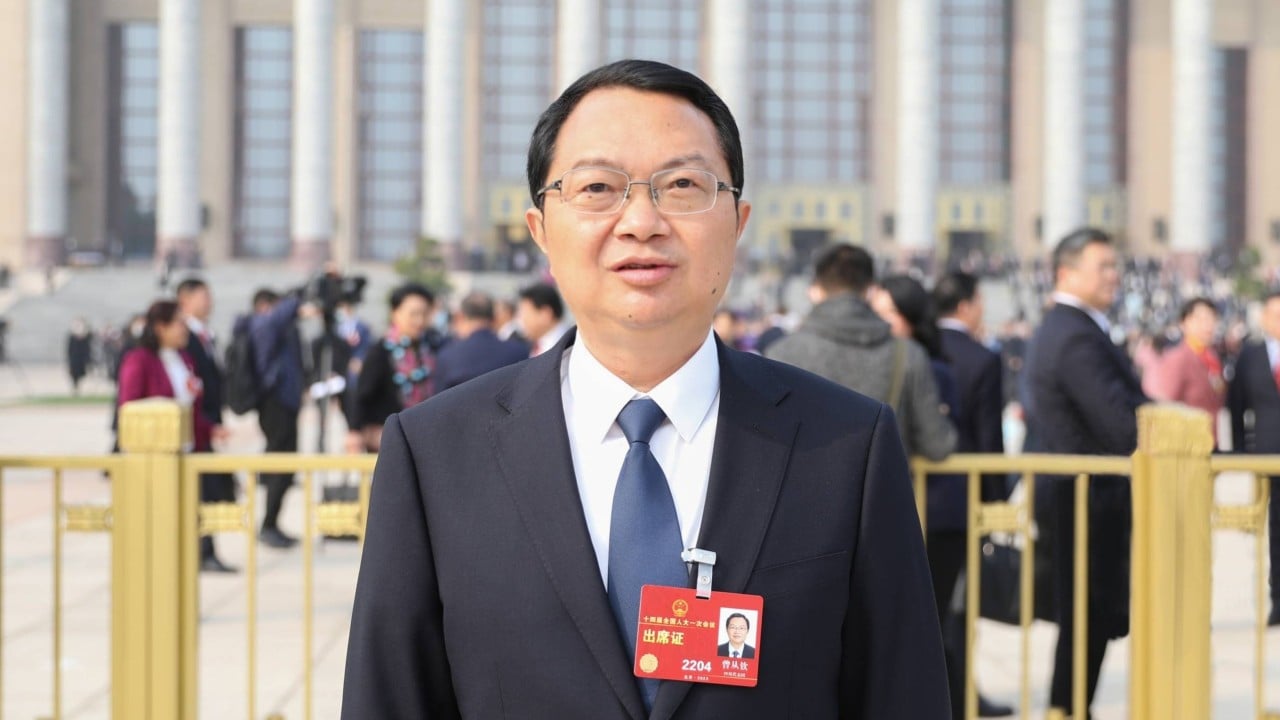
The news hit the wires late Saturday night, and it wasn’t just another corporate update. Zeng Congqin, the man steering Wuliangye Yibin—China’s second-largest liquor producer—is officially under investigation for "serious violations of party discipline and law." In the world of Chinese state-owned enterprises, that’s the standard code for a corruption probe that usually ends in a courtroom.
If you’ve been following the Chinese market, you know this isn't an isolated incident. It’s a seismic shift. Wuliangye is a behemoth with a market cap that has regularly hovered around the 400-billion-yuan mark. When the person at the very top of a cultural and economic pillar like this gets taken away, it sends a message that no one is untouchable.
The Fall of the Baijiu King
Zeng Congqin isn't a newcomer to the Yibin scene. He’s a local who climbed the ranks through the political system before jumping into the driver’s seat at Wuliangye in 2019. By 2022, he was the Chairman and Party Secretary. To understand why this matters, you have to look at the timing. Just a few days before he vanished from the leadership list, he was giving speeches about "anti-corruption integrity" and "risk prevention." The irony is thick enough to choke on.
This isn't just about one guy, though. Zeng is actually the second Wuliangye chairman in a row to fall into the crosshairs. His predecessor, Li Shuguang, was put under investigation in early 2025. It feels like a revolving door of leadership where the exit leads straight to a disciplinary hearing.
A Pattern of Purges in the Liquor Industry
If you think Wuliangye is the only one feeling the heat, you're mistaken. The entire high-end liquor sector—the "Baijiu" market—is under a microscope. Look at Kweichow Moutai, the only company bigger than Wuliangye in this space. Their former chairmen, Yuan Renguo and Gao Weidong, didn't just lose their jobs; they got life sentences. Even the most recent head, Ding Xiongjun, found himself under investigation in 2025.
Why the liquor industry? It’s simple. Baijiu isn't just a drink in China; it’s currency. It’s the lubricant for backroom deals and the center of gravity for "excessive banquets." Beijing has spent the last year hammering down on these displays of wealth. In May 2025, a revised regulation basically banned alcohol at official receptions. That wasn't just a lifestyle change—it was a direct hit to the bottom line of these companies.
The Numbers Don’t Lie
The financial fallout of this anti-corruption drive is staggering. We aren't talking about a slight dip in growth. Wuliangye’s third-quarter results for 2025 showed a revenue collapse of 53%, with net profits tanking by 66%.
When the government says "no more banquets," the demand for a 2,000-yuan bottle of clear spirit evaporates overnight. Investors are spooked, and honestly, they should be. Goldman Sachs reported last year that institutional funds are deeply worried that this crackdown is hitting consumption so hard it might drag down the broader economy.
Why the Crackdown is Different This Time
- The "Tigers and Flies" Strategy: This isn't just about catching small-time crooks. The 2025-2026 wave is targeting "tigers"—the high-ranking executives and military officials.
- Systemic Clean-up: Authorities aren't just looking for bribes. They're looking at "collusion between officials and businessmen," a phrase that appears more and more in official communiqués.
- Sector-Specific Targets: High-risk sectors like finance, energy, and tobacco are being purged alongside liquor.
What This Means for Investors and Partners
If you’re holding stock or doing business with these giants, "business as usual" is a fantasy. While Wuliangye’s official statement says the probe won't have a "major impact" on operations, history suggests otherwise. A leadership vacuum at a state-owned enterprise (SOE) usually leads to a period of paralysis. Decisions don't get made, and contracts get scrutinized with a magnifying glass.
The reality is that the "golden era" of easy growth fueled by government hospitality is over. The liquor industry is now in a period of "deep adjustment." You're seeing companies try to pivot to younger consumers or international markets, but you can't replace billions in lost banquet revenue with a few trendy cocktails.
Navigating the New Normal
Don't expect the pressure to let up. The Central Commission for Discipline Inspection (CCDI) has already signaled that 2026 is going to be even tougher. They’re moving into the "15th Five-Year Plan" period with a mandate to "eradicate the breeding ground" for corruption.
If you're looking at the Chinese market, stop looking at just the P/E ratios. Start looking at the political climate. The downfall of Zeng Congqin is a reminder that in a state-led economy, the most important "risk factor" isn't the competition—it's the discipline inspection.
Keep a close eye on the upcoming leadership appointments at Wuliangye. Whoever steps in will have the unenviable task of trying to grow a business while the very culture that built it is being dismantled by the state. If you're an investor, it's time to re-evaluate your exposure to luxury sectors that rely on "business-government interactions." Those days aren't just fading; they're being legislated out of existence.