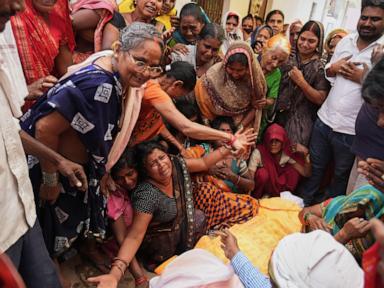
The headlines are predictable, mournful, and fundamentally dishonest. Every time a massive squall line tears through Uttar Pradesh or Rajasthan, leaving a trail of collapsed walls and shattered lives, the media treats it like a biblical anomaly. They call it an act of God. They call it a "freak weather event." They count the bodies—96 this time, maybe more next time—and then they move on until the next dust cloud blocks out the sun.
Stop calling these deaths a tragedy of nature. They are a tragedy of engineering and bureaucratic cowardice.
The "lazy consensus" suggests that we are helpless against the sheer kinetic energy of a 130 km/h wind. This is a lie. People aren't dying because the wind is too strong; they are dying because their infrastructure is a century out of date and their "early warning systems" are effectively digital paperweights. We are treating a recurring, predictable meteorological phenomenon as if it’s a black swan event. It isn't. It’s a failure of the grid, the code, and the soul.
The Geography of Neglect
We need to talk about the "Andhi." In northern India, these aren't just storms; they are a seasonal ritual. Cold air from the Himalayas meets the blistering heat of the Thar Desert. The result is a vertical stack of atmospheric instability that creates a downburst. This isn't secret science. We’ve known the physics of this since the British Raj.
Yet, the mainstream narrative focuses on "relief funds" after the fact. Why are we talking about compensation when we should be talking about lateral wind loads?
The majority of these 96 deaths occurred because of "wall collapses." In the rural heartland, construction is often a mix of unreinforced masonry and wishful thinking. When a dust storm hits, the pressure differential between the inside and outside of these structures creates a vacuum effect. They don't just fall; they explode inward or outward.
If we actually cared about saving lives, the conversation wouldn't be about climate change—which is a convenient scapegoat for every local failure—it would be about the National Building Code of India. We are building 21st-century populations on 19th-century foundations. Every death attributed to a falling wall is a failure of local governance, not an "unprecedented" surge in wind speed.
The Lightning Paradox
Lightning is the most underreported mass killer in the tropics. During these northern storms, the electrical discharge is staggering. The media frames this as "bad luck."
I have spent years looking at disaster mitigation data, and the pattern is clear: lightning kills the poor because the poor are the only ones left outside. This is a socio-economic filter disguised as weather. Farmers stay in the fields to protect equipment or livestock because they have no financial safety net.
Furthermore, the "lightning arrestors" on rural schools and government buildings are frequently stolen for scrap metal or were never connected to a proper ground in the first place. You can have the best Doppler radar in the world, but if the building meant to be a shelter is actually a giant copper-topped lightning rod with no path to the earth, you are just inviting the bolt inside.
The Failure of the "Smart" Warning
"People were caught off guard," the reports say.
How? In an era where even the most remote village in Bihar has 4G access, how is anyone "caught off guard" by a storm front that is fifty miles wide and visible on satellite for hours?
The problem is the Information Gap of Authority. The Indian Meteorological Department (IMD) issues "Yellow" or "Orange" alerts. To a farmer in a field, what does "Orange" mean? Does it mean "take cover now" or "it might rain later"? These warnings are written by bureaucrats for other bureaucrats. They lack the granular, localized urgency required to move a population.
We don't need better satellites. We need better semantics.
Imagine a scenario where the warning system isn't a vague text message but a localized, automated siren triggered by real-time wind sensors. We have the tech. We have the "Nano" level sensors. We just don't have the will to deploy them because it’s cheaper to pay out "death ex-gratia" than it is to build a resilient warning network.
The Dust Storm as a Tech Failure
We love to talk about India as a tech superpower. We have Chandrayaan on the moon, but we can't keep the power lines up in Agra when it gets breezy.
The death toll from these storms is inflated by "secondary casualties"—electrocution from falling high-tension wires. This is purely a maintenance and design issue. In any modern power grid, a line snap should trigger an instantaneous circuit break. In northern India, these lines often stay live while dancing on the ground in a puddle of rainwater.
We are using "robust" as a buzzword in Bangalore boardrooms while the actual physical grid is held together by rust and prayer.
Why the "Climate Change" Narrative is a Trap
When we blame these 96 deaths on climate change, we give the local officials a "Get Out of Jail Free" card.
"Oh, the weather is getting more extreme," they shrug. "What can we do?"
It’s a convenient mask for incompetence. While global temperatures are rising and atmospheric energy is increasing, the wind speeds recorded in these recent storms are well within the design parameters of modern engineering. A well-built warehouse shouldn't collapse in a 100 km/h wind. A modern power pole shouldn't snap like a toothpick.
By framing this as a global environmental crisis, we stop looking at the local corruption that allowed sub-standard cement to be used in public housing. We stop looking at the illegal encroachment of drainage areas that turns every storm into a flood. We stop holding the right people accountable.
The Brutal Reality of Rural Resilience
The hard truth nobody wants to admit is that we have accepted a certain "baseline of death" for the rural poor.
If 96 people died in a single afternoon in South Delhi because of a windstorm, there would be a national inquiry, three resignations, and a total overhaul of the municipal code by Monday. But because these deaths happen in the dust-choked villages of the North, we treat it as a seasonal tax paid to nature.
We talk about "resilience" as if it’s a personality trait of the Indian farmer. It’s not. It’s a survival mechanism born of being ignored. They are resilient because they have to be, not because they should have to be.
Stop Studying, Start Hardening
I’ve seen committees spend millions on "feasibility studies" for disaster management. We don't need more studies. We need:
- Mandatory Grounding: Every structure over a certain height in the "Storm Belt" must have a verified, inspected lightning conductor. No exceptions.
- The "Kill Switch" Mandate: Utility companies must be held legally liable for deaths caused by live wires during storms. Watch how fast they install automatic breakers when it hits their balance sheet.
- Wind-Load Retrofitting: Provide subsidies for steel reinforcement in rural housing. A bag of rebar is cheaper than a coffin.
- Hyper-Local Audio Alerts: Move away from SMS-based warnings. Use the local mosque or temple loudspeakers—already connected to every village—as a synchronized emergency broadcast system.
The "freak storm" is a myth designed to protect the status quo. These storms are coming back next year. They are coming back the year after that. If the death toll remains the same, it isn't because the wind got stronger—it's because we stayed weak.
Build for the wind or bury the dead. Pick one.